Celebrities Who Do Bikram Yoga, and What Busy Men Can Copy at Home
By Mr. Ian Terry, E-RYT 500, founder of YogaFX · Published
Celebrities who do Bikram yoga include NBA stars, a Wimbledon champion and boxing world champions. Most of them keep it simple: a fixed routine, a regular slot and steady breathing. Busy men can copy those habits at home, without a hot room or a famous schedule.
That is the point of this guide. Plenty of lists stop at the names. Here we read what each athlete actually said, check the science, and turn it into habits for a man with a full diary. Mr. Ian Terry, E-RYT 500 and Founder of YogaFX, has taught more than 12,000 hours, and he sees the same patterns in students who arrive from desk jobs, gyms and sports clubs.
If you want the longer research list, our companion guide covers the athletes and stars on record in more detail. This page is the practical version for people who train online first.
This article is part of our Hot Yoga for Men guides.
Celebrities Who Do Bikram Yoga: The Names on Record
Every list of celebrities who do Bikram yoga online repeats the same famous faces. We only list people whose practice is documented in their own words or by a named outlet. The label in the second column is the one the source used, because some report Bikram yoga and others say hot yoga. That difference matters, so we keep it.
| Name and sport | Practice as reported | What the source says | Habit to copy at home |
|---|---|---|---|
| Kareem Abdul-Jabbar, NBA | Bikram yoga | Started in 1970 and said the postures "really lengthened my career" (The National, 2014). | Treat it as a long game. Keep the habit for years, not weeks. |
| Joe Johnson, 7x NBA All-Star | Hot yoga | Began in 2009 for knee and Achilles tendonitis, in 90-minute classes at 105°F, and later opened his own studio (ESPN, 2014; Andscape, 2021). | Use it as a recovery habit on lighter training days. |
| Andy Murray, tennis | Bikram yoga | Took it up in 2007 and credited it with his fitness and mental strength (The National; ANI). | Practise steady breathing when you are tired, not only when you are fresh. |
| Aaron Rodgers, NFL | Hot yoga | Spent three months of the 2014 off-season on hot yoga (Sports Illustrated, 2014). | Run a focused block of about twelve weeks, then review how you feel. |
| Brandon Bass, NBA | Bikram yoga | Went twice a week for 90 minutes, for lengthening, strengthening and balance (NBC Sports Boston). | Book two fixed sessions a week and protect them like meetings. |
| Lane Kiffin, college football coach | Hot yoga | Has started his days with early classes for years (The Rebel Walk, 2022; USA Today, 2025). | Practise before work, when the diary cannot interrupt you. |
| Joe Rogan, UFC commentator | Hot yoga | Posted about his 90-minute hot yoga sessions on X in 2018, describing the mental effect. | Use the session to clear your head, not to chase a score. |
| Anthony Crolla, boxing world champion | Bikram yoga | Credited it for his breathing and admitted he often just wanted the class to end (BoxingScene, 2013). | Stay with the discomfort and breathe through it. |
What the table tells us
Read the table again and one thing stands out about the celebrities who do Bikram yoga. Nobody on it describes a clever trick. They describe a schedule: twice a week, early mornings, a three-month block. The practice itself is fixed, so the effort goes into turning up.
Two honest notes about these celebrities who do Bikram yoga. First, the quotes come from interviews and press coverage, so we report them as what the person said, not as proof of any health result. Second, many of these players had trainers, physios and time. A man with two children and a commute needs a smaller version of the same idea.
What the Research Says About the Hot Room
Many articles on celebrities who do Bikram yoga stop at the quote. Fame is not evidence, so here is what published studies found. We open each paper before quoting it, and we link the ones we could read. This is not medical advice. If you have heart disease, high blood pressure or any condition that heat could affect, ask a doctor first.
Strength and flexibility
In a small randomised study, young adults who did 24 Bikram sessions in 8 weeks improved their deadlift strength and lower back and hamstring flexibility compared with a control group. They also lost a modest amount of body fat. Their aerobic fitness did not change (Tracy and Hart, 2013). The sample was only 21 people, so treat it as an early signal, not a promise.
A wider look agrees on the direction. A 2025 systematic review gathered 43 hot yoga studies with 942 participants, and 76% of them were women. It found that hot yoga raised body temperature and heart rate, but did not raise energy demand compared with non-heated yoga (Willmott et al., 2025).
Heart rate and calories
Heat changes how the heart works, even when the effort feels the same. In a crossover study of 14 people, oxygen use was the same in a hot room and a cool one. Yet heart rate sat at 67.0% of maximum in the heat, against 60.8% at room temperature (Boyd et al., 2018). So the hot room adds load to the heart without adding load to the joints.
People also ask how many calories a class burns. In a laboratory study of 24 people, a full 90-minute class averaged 286 kcal, with a range from 179 to 478 (Pate and Buono, 2014). That is far below the 1,000 calories some studios claim. For more on the numbers, read our guide to hot yoga heart rate zones.
Mood
The strongest mental health result comes from Massachusetts General Hospital. In an 8-week trial, 59.3% of people in heated yoga classes had at least a 50% drop in depression symptoms, against 6.3% on a waiting list. About 81.5% of the 65 people analysed were women, so the result tells us less about men (Nyer et al., 2023). It is also not a substitute for treatment.
The last card matters for busy men. The World Health Organization advises adults to get at least 150 minutes of moderate-intensity activity a week. Three classes of 90 minutes would cover it. But so would five 30-minute sessions at home, which is why the habits below matter more than the room.
Why Celebrities Who Do Bikram Yoga Stay With It
Athletes who do hot yoga have plenty of other ways to train, so why do these names return to the same 90 minutes? NBA players hot yoga routines tell a similar story, and what athletes do hot yoga for is rarely glamorous. The sources point to a few practical reasons, and none of them needs fame.
- It is structured. The sequence is fixed, so nobody has to plan the session. A tired man can follow the spoken dialogue without making a single decision.
- It targets what sport wears down. Joe Johnson came for his knee and Achilles, and Brandon Bass named lengthening, strengthening and balance. These are the areas that tighten after years of lifting, running or sitting.
- It trains the head as well. Andy Murray linked it to mental strength, and Joe Rogan wrote about the mental effect. Holding a posture while hot and tired is a skill in itself.
- It is hard to fake. Anthony Crolla admitted he often wanted the class to end. That honesty is useful, because the discomfort is part of what the practice teaches.
Put plainly, celebrities who do Bikram yoga mostly use it as a reliable weekly anchor. They are not chasing a miracle. They are protecting a routine, and that is the part an amateur can copy with no budget at all.
There is one caution. A famous name practising something does not show it is safe or effective for you. Every body, injury history and heart is different, so use the examples as inspiration and the studies as a guide, then check with a doctor if you have any doubt.
Six Habits Busy Men Can Copy From Celebrities Who Do Bikram Yoga
You don't need a famous schedule or a hot studio to use what these athletes did. You need a routine you can keep. Here are six habits drawn from Table 1, with the reason each one works.
- Fix the sequence. The 26-posture class never changes, so you always know what comes next. At home, pick five or six postures and repeat them in the same order. That makes progress visible, posture by posture.
- Book the slot. Brandon Bass went twice a week and Lane Kiffin goes early. Put two or three sessions in your calendar as fixed appointments, and treat a missed one as a skipped meeting.
- Practise before the day starts. A morning session finishes before work, traffic or the children can interrupt it. Even 20 minutes counts.
- Breathe on purpose. Murray and Crolla both credit breathing. Spend the first two minutes on slow breaths, in the style of our guide to the two breathing exercises.
- Drink before you start. Heat and sweat cost fluid. Our guide to hot yoga hydration sets out simple water habits for busy adults.
- Finish with stillness. End every session with two or three minutes lying down, as in our note on the benefits of final rest.
The list of celebrities who do Bikram yoga is long, but the habits behind it are short. Notice what is missing: a hot room. Heat is part of the studio class, and the research above suggests it adds real load to the heart. But the habits that kept these athletes practising are the same at any temperature.

A 20-Minute Home Routine Built From the Studio Postures
This is a sample, not a prescription. It uses postures that are easy to check yourself, and it runs at room temperature. Don't heat a room at home to mimic a studio. Studio heat is controlled and supervised, and an overheated living room is not.
- Minutes 1 to 3: slow breathing. Stand tall and breathe in and out through the nose. Keep the pace even.
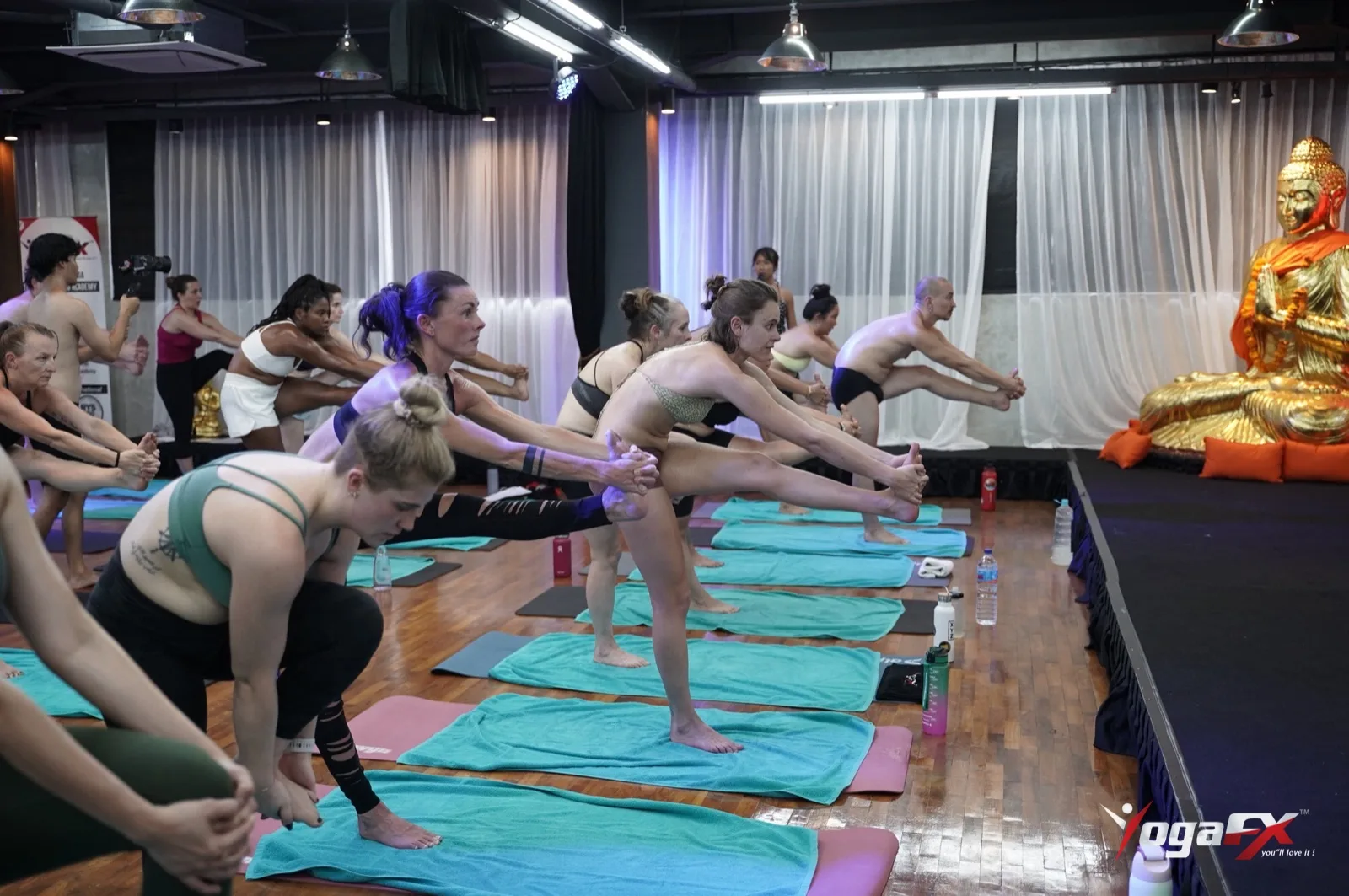
- Minutes 4 to 8: Awkward pose (Utkatasana). Sit back as if into a chair, arms forward. Our cues for awkward pose help you check your alignment.
- Minutes 9 to 13: Eagle pose. Wrap arms and legs, fix your eyes on one point and hold. Practise both sides.
- Minutes 14 to 17: Triangle pose. Keep the legs strong and the chest open.
- Minutes 18 to 20: final rest. Lie on your back, breathe slowly and let the heart rate settle.
Keep the effort moderate. If you feel dizzy, stop and sit down. If you are new to hot yoga, our guide on preparing at home before your first class explains how to build up. Remember that a video or an article cannot replace a teacher, and a first in-person class is worth the trip.
Start small and build up
Men who copy celebrities who do Bikram yoga often start too big. They try ninety minutes on day one, ache for a week and drop the habit. Start with 20 minutes at room temperature, add a session when it feels easy, and keep a simple note of how each posture feels.
Why start with a short routine? Because consistency beats intensity for most people. The man who does 20 minutes three times a week for a year will usually be further along than the man who does one heroic hour and then quits. That is also how Mr. Ian Terry advises his own trainees to build the sequence before they ever stand in front of a class.
What YogaFX Students Say
Stories about celebrities who do Bikram yoga are one thing. Here's what ordinary students say after training with us. These are short extracts from our YouTube reviews, with first names only.
"It was amazing to live this two weeks with you. I feel so full of joy and happiness."
Barbara, YouTube review, 2024
"I'm really proud of all of us."
Laura, YouTube review, 2024
"It has been lifechanging."
Fabiola, YouTube review, 2024
The video above is Barbara's full review. We have collected 557 reviews across Google, Yoga Alliance and YouTube, and you can read them before you decide anything. None of them promises a celebrity result, and that is the honest part: the practice rewards people who turn up, whoever they are.
From Home Practice to Teaching With Mr. Ian Terry
Some men start copying these habits and find they want more: a deeper practice, or a second career. That is where YogaFX comes in. Mr. Ian Terry, E-RYT 500, has taught more than 12,000 hours, and YogaFX has trained more than 1,500 graduates from over 80 countries since 2017.
Our online course costs USD 329, or 4 x USD 82, and it prepares you for the Bali intensive by teaching the postures, the dialogue and the breathing from home. You study at your own pace and build the same fixed routine this article describes. Our guide to yoga teacher training cost sets out what the online tuition and the Bali trip involve.
Whether you follow celebrities who do Bikram yoga or simply want a sturdier body, the first step is small. Start with one session. Pick your six postures, book your three slots and start this week. When you are ready to talk about training, message Mr. Ian and the YogaFX team on WhatsApp and we will answer your questions personally.
Health note: This article is general information, not medical advice. Consult a healthcare professional before starting any new exercise routine, especially if you have a heart condition, high blood pressure or take regular medication.
FAQ
Which celebrities do Bikram yoga?
Celebrities who do Bikram yoga on record include Kareem Abdul-Jabbar, Andy Murray, Brandon Bass and boxer Anthony Crolla, who all reported Bikram classes. Joe Johnson, Aaron Rodgers, Lane Kiffin and Joe Rogan reported hot yoga. Check each source, because the two practices differ.
Is Bikram yoga the same as hot yoga?
Not exactly. Bikram yoga is a fixed class of 26 postures and 2 breathing exercises over 90 minutes in a heated room. Hot yoga is a broader term for any yoga in a warm room, with varied sequences. Many articles use the two words loosely, so always check which one a source means.
Is Bikram yoga safe for busy men with desk jobs?
For most healthy adults it can be, if they build up gradually, drink enough water and rest when needed. Men with heart disease, high blood pressure or other conditions should ask a doctor first. Heat raises heart rate, so listen to your body and leave the room if you feel dizzy.
Can I get the same results at home without a hot room?
Not exactly. A study of 14 people found heart rate was higher in a hot room than a cool one at the same oxygen cost. Home practice at room temperature still builds the routine, the breathing and the flexibility. Do not overheat your home to copy a studio.
Is this training affiliated with Bikram Choudhury?
No. YogaFX is independent training and is not an official Bikram Choudhury Teacher Training. Our teacher training is led by Mr. Ian Terry, E-RYT 500, and teaches the Hot 26&2 sequence and dialogue. You study online first and then complete the intensive in Bali with our team.
Still have questions? Message Mr. Ian and the YogaFX team on WhatsApp and we will answer them personally: chat on WhatsApp.