Pranayama Breathing: The 2 Breathing Exercises Taught Online
By Mr. Ian Terry, E-RYT 500, founder of YogaFX · Published
Pranayama breathing in a 26&2 class is a pair of exercises: Standing Deep Breathing opens the 90 minutes and Kapalbhati closes them. You can start learning the first one online, at a desk, in five minutes a day. Here is how that works, and why we call it your inner thermostat.
This guide comes from the online teaching team at YogaFX. Mr. Ian Terry, E-RYT 500, Founder and Lead Instructor, has taught more than 12,000 hours, and the way we explain the breath follows his classroom habits. It’s general education, not medical advice. If you have a heart, lung or blood pressure condition, or you are pregnant, speak to a healthcare professional first.
You will find the two exercises, a five-minute desk practice, the science behind a nasal breath, three student reviews and a short FAQ below. If you want the version written for students in the studio, see this 26 and 2 class guide to the breathing. This page is for adults who are studying online first.
This article is part of our Bikram yoga teacher training guides.
Pranayama Breathing in the 26&2: The Two Exercises
Every class has the same two breathing exercises, in the same two places. That fixed order makes them easy to plan for. The table shows what each one asks of you and how an online student can prepare.
| Exercise | Where it sits | How it feels | How to prepare online |
|---|---|---|---|
| Pranayama (Standing Deep Breathing) | First, before any posture | Slow, steady, led by the spoken count | Practise the slow nasal pattern at a desk, five minutes a day |
| Kapalbhati (Blowing in Firm) | Last, after the final posture | Quick, forceful exhales | Read about it, then learn it with a teacher in the room |
| Normal breath between postures | Throughout the class | Calm and nasal where you can | Notice your breath whenever you stand or sit during the day |
Notice the last column. We ask online students to practise only the first exercise at home. The closing exercise is quicker and more forceful, so it belongs in the room with someone watching.
What the word pranayama means
Pranayama is Sanskrit for breath control. Many yoga styles use it for a long menu of techniques. In the 26&2 it names one exercise, done standing, led by a script. That narrow meaning surprises people who search for pranayama breathing techniques and find pages about alternate nostril breathing or ratios and holds.
- No ratio to memorise. The teacher's count sets the length of each breath.
- No breath holds. You breathe in and out, then you move on.
- No finger positions. Your hands go where the dialogue puts them.
That simplicity is deliberate, because a new student in a hot room needs one small job at the start. Our guide to the Bikram yoga dialogue explains why a fixed script helps you follow without thinking.
Why Pranayama Breathing Is a Smart Place to Start Online
Most adults who find us have a job, a commute and a full diary. Learning a 26-posture sequence from a screen is hard. Pranayama breathing is easy by comparison, so it pays off in every class afterwards.
There are three reasons it works well as a first lesson:
- It needs no heat. You can do the slow breath at 22°C in your kitchen. The posture work still needs the room.
- It needs no kit. A chair with a supported back, or a little floor space, is enough.
- It builds the habit you will lean on. When the standing series gets hard, the dialogue reminds you to breathe. You will reach for the pattern you practised.
Our hybrid teacher training guide shows how the online part fits around a day job. The online course costs USD 329, or 4 x USD 82, and you finish the practical week in Bali afterwards. Pranayama breathing is one of the first things you can rehearse before you fly, and it costs you nothing extra.
What online study can and cannot teach
Be honest about the limits. A video can show you the pattern, but it can’t tell you whether you are gulping air or lifting your shoulders. So we pair the online part with live teaching. If you want to see how far you can take the rest of the class at home, read our piece on original hot yoga at home.
A Five-Minute Desk-Side Pranayama Breathing Practice
Here is a short pranayama breathing routine you can do between meetings. It borrows its steps from the NHS breathing exercise for stress, which you can do standing, sitting in a chair that supports your back, or lying down. It is a practice version, not the class script, and it does not replace a teacher.
- Settle. Stand tall or sit with your back supported. Let your shoulders drop.
- Breathe in through the nose. Slowly and gently, counting steadily from 1 to 5 if that helps.
- Let it out through the mouth. Release the breath gently, counting 1 to 5 again. Do not push.
- Keep it flowing. Let the breath go deep into the belly as far as is comfortable, without forcing it.
- Repeat for five minutes. Then breathe normally for a few seconds and notice how you feel.
The wording here is the NHS's, so it says to let the breath flow deep down into the belly "as is comfortable, without forcing it". The phrase without forcing it is the one we repeat to students most often.
Your five-minute plan, minute by minute
| Minute | What you do | What to notice | Class link |
|---|---|---|---|
| 1 | Stand or sit tall, shoulders down, eyes soft | Where you hold tension | The class opens standing tall in front of the mirror |
| 2 | Slow breath in through the nose, count 1 to 5 | Does the chest or the belly rise first? | The teacher's spoken count sets the pace |
| 3 | Release the breath out through the mouth, count 1 to 5 | Is the exhale a gentle release? | An open-mouth exhale gives a clear, felt end to each breath |
| 4 | Keep the same rhythm, a little slower than feels natural | Do you rush when you get bored? | In a warm room people hurry, so a slow count helps |
| 5 | Return to normal breathing for a few seconds | Heart rate, jaw, shoulders | The first posture begins straight after |
Do this pranayama breathing practice five days a week for a month, and the pattern becomes automatic. For example, add a short note after each session: where you rushed, where you relaxed. As a result, a trainee who keeps those notes arrives in Bali with real questions, and real questions get better answers.
When to stop
Pranayama breathing is a skill, not a test. Stop and breathe normally if you feel dizzy, light-headed or tingling. Sit down. Drink some water. If the feeling does not pass, stop practising and speak to a doctor.
The Inner Thermostat: How Nasal Breathing Meets the Heat
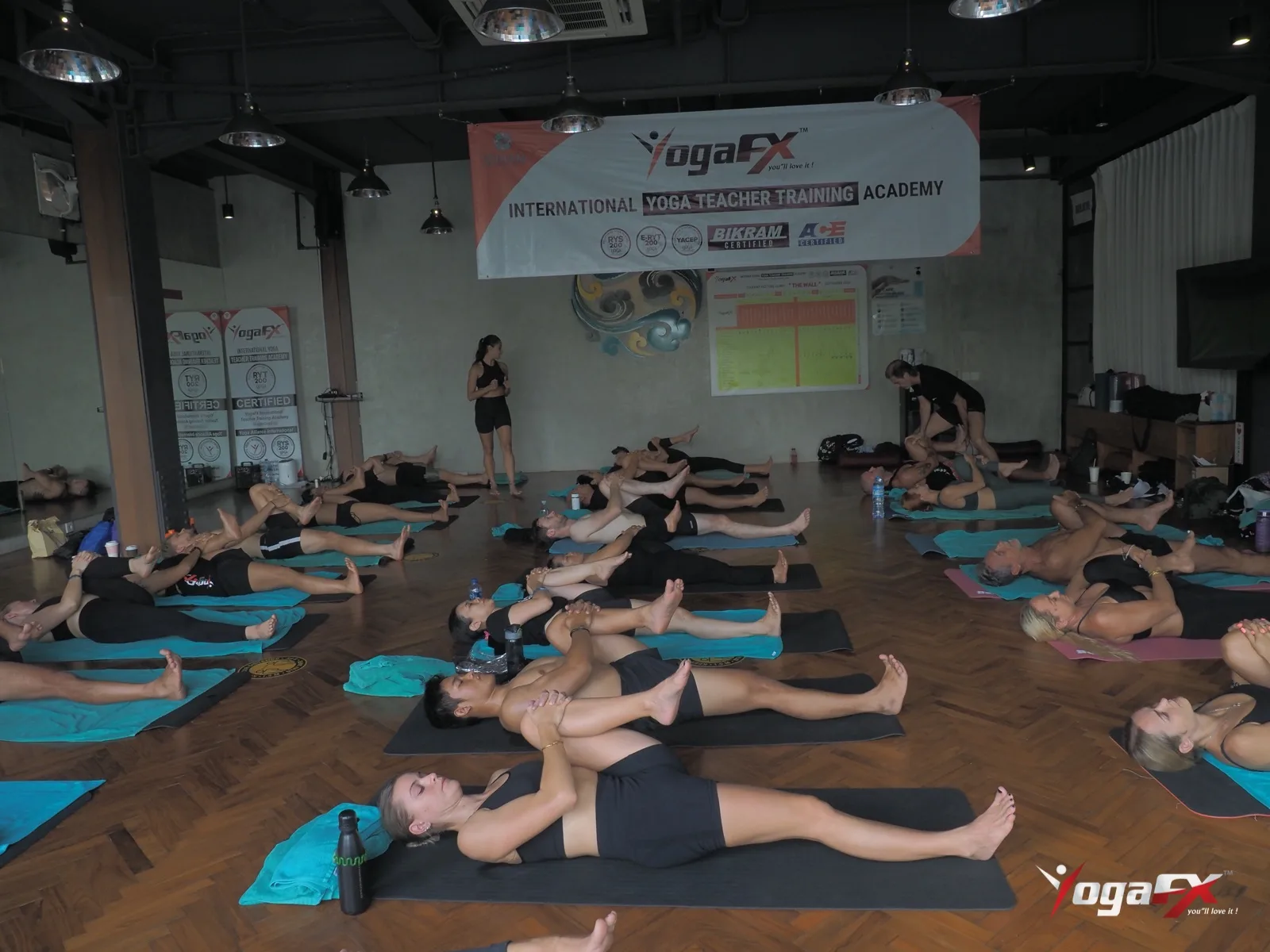
A YogaFX room sits at about 40°C with about 40% humidity, and your body works to stay cool all class. At YogaFX we call your breath the inner thermostat. That phrase is our teaching view, not a research finding, so here is what we mean by it.
When the heart rate climbs in the heat, many people gulp air through the mouth. The breathing turns fast and shallow, so the effort feels bigger than it is. In our experience, students who slow down and keep the inhale nasal settle sooner. We cannot promise a measurable result, and we know of no study that tested nasal breathing inside a 40°C yoga room.
What the nose does that the mouth does not
The Cleveland Clinic says plainly that "breathing through your nose is the most beneficial way to breathe". It lists the reasons:
- Filtering. The cilia in your nasal passage filter out debris from the air.
- Warming. The nasal passages warm, and sometimes cool, the air on its way to your lungs.
- Humidifying. The passages are designed to humidify the air you breathe. Your mouth is not.
- Nitric oxide. The page describes this molecule as a vasodilator, which means it opens up your blood vessels.
The same page is fair about mouth breathing. It says there are only two times you really need it: when you need more air to your lungs quickly, and when your nose is blocked by congestion, allergies or a cold. That matters in a hot room. If your breath runs away from you, use your mouth instead, slow down and rest.
When the heat pushes back
A good thermostat needs a safety setting. The US Centers for Disease Control and Prevention says, "If your body gets too hot, you can get sick." It lists these symptoms of overheating: muscle cramping, unusually heavy sweating, shortness of breath, dizziness, headaches, weakness and nausea.
If you notice any of them in class, your breathing exercise is over. Sit or lie down, sip water and let your body cool. Our guide to hot yoga hydration covers the water habits that help, and our page on hot yoga temperature explains the room itself.
What Health Bodies Say About Slow Breathing and Yoga Safety
The research on pranayama breathing inside a hot yoga room is thin. Health bodies do give clear, practical guidance, though, and it matches the way we teach.
Slow, gentle and not forced
The NHS page asks you to breathe in gently and regularly, and to let the breath flow out gently. It describes its exercise as something that takes "just a few minutes" and suggests repeating it for at least 5 minutes. It makes no big promises about stress, and neither do we. It simply offers a free tool you can use anywhere.
Be careful with forceful breathing
The US National Center for Complementary and Integrative Health, part of the National Institutes of Health, says that if you are new to yoga you should "avoid extreme practices such as headstands, shoulder stands, the lotus position, and forceful breathing". Its yoga effectiveness and safety page also notes that hot yoga has "special risks related to overheating and dehydration".
That’s exactly why we ask online students to practise only the slow opening breath at home. Kapalbhati is a quick, forceful exercise. Learn it in the room, where a teacher can show you a gentler version.
What we are not claiming
Pranayama breathing is a skill, not a treatment. We do not say it clears the body, changes your blood pressure or treats anxiety. If you have a medical condition, your doctor decides what is safe. We teach a calm, careful way to breathe and move in the heat, and we leave the medical advice to medical professionals.
Five Mistakes to Avoid When You Practise Pranayama Breathing Alone
- Breathing too fast. The mind wants to hurry. Let the count be slower than your instinct.
- Lifting the shoulders. If your shoulders rise with every inhale, drop them and start again.
- Forcing the exhale. The exhale is a release. Clamping the lips or pushing the air out works against you.
- Copying the closing exercise. Skip Kapalbhati at home until a teacher has shown you.
- Pushing through a warning sign. Dizziness or tingling means stop, sit and breathe normally.
Most pranayama breathing slips fix themselves with one change: slow down. If one keeps coming back, mention it when you join the live part of the course. Teachers love a specific question, because it shows you’re paying attention.
What Our Trainees Say
Reviews do not prove that pranayama breathing works, but they show what the training feels like. These come from graduates. We use first names only.
“Highly knowledgeable and competent teachers will change yourself for the better. Strongly recommend this place for everyone's willing to bring their flexibility, strength, focus, breathing or even balance to the next level.”
Thibaut, Google review, 2018
“This is beyond my expectations for the program.”
Cristine, YouTube video review, 2024
Ruby, in a YouTube video review from 2025 (paraphrased), praised Mr. Ian's work over the training days and said that, while others caught up with the dialogue, she was still working through the pranayama part herself. You can watch her review below.
Cristine’s video review is also on the YogaFX YouTube channel.
Learning Pranayama Breathing With YogaFX, Online and in Bali
Mr. Ian Terry spent five years, from 2014 to 2019, training with the founder of the Bikram Hot 26&2 method. He founded YogaFX in 2017 and teaches the scripted dialogue word for word. Pranayama breathing is also the first exercise of every class, so the rest of the class builds on it.
The online course costs USD 329, or 4 x USD 82. You study the dialogue, the posture order and the safety basics from home, then finish in Bali. Prefer to feel the room first? The Free 1-Day Guest Pass at our Seminyak studio gives you a first class at no cost. Message Mr. Ian on WhatsApp to book it or to ask about the next intake.
FAQ
What is pranayama breathing?
Pranayama is the Sanskrit word for breath control. In a YogaFX 26&2 class it names the first of two breathing exercises, Standing Deep Breathing, which opens the 90 minutes. The second, Kapalbhati, closes the class. Together they are the 2 breathing exercises in the name 26&2.
Should pranayama breathing be through the nose or the mouth?
In a 26&2 class you breathe in slowly through the nose and let the breath out through an open mouth. The NHS suggests the same pattern in its stress exercise. Cleveland Clinic says mouth breathing is fine when you need more air quickly, or when your nose is blocked.
How long should I practise pranayama breathing at my desk?
Five minutes is a good start. The NHS stress exercise says to repeat its steps for at least 5 minutes. Count steadily from 1 to 5 on each inhale and exhale if that helps, and never force the breath. Stop and rest if you feel dizzy.
Can I learn pranayama breathing online?
Yes, the first exercise is a good one to learn online. The slow nasal pattern needs only a chair or a little floor space. The class itself adds the 40°C room and a teacher who watches you, which video cannot copy. That is why YogaFX pairs online study with a week in Bali.
Is pranayama breathing safe for beginners?
Slow, gentle breathing suits most beginners, but check with a healthcare professional first if you have a heart, lung or blood pressure condition, or if you are pregnant. The US National Center for Complementary and Integrative Health advises new students to avoid forceful breathing, so learn the closing exercise with a teacher.
Still have questions? Message Mr. Ian and the YogaFX team on WhatsApp and we will answer them personally.
This guide is general education, not medical advice. Please consult a healthcare professional before you begin or change a breathing or hot yoga routine, especially if you are pregnant or have a heart, lung or blood pressure condition.