Hot Yoga Heart Rate: Zones to Know Before You Teach or Train
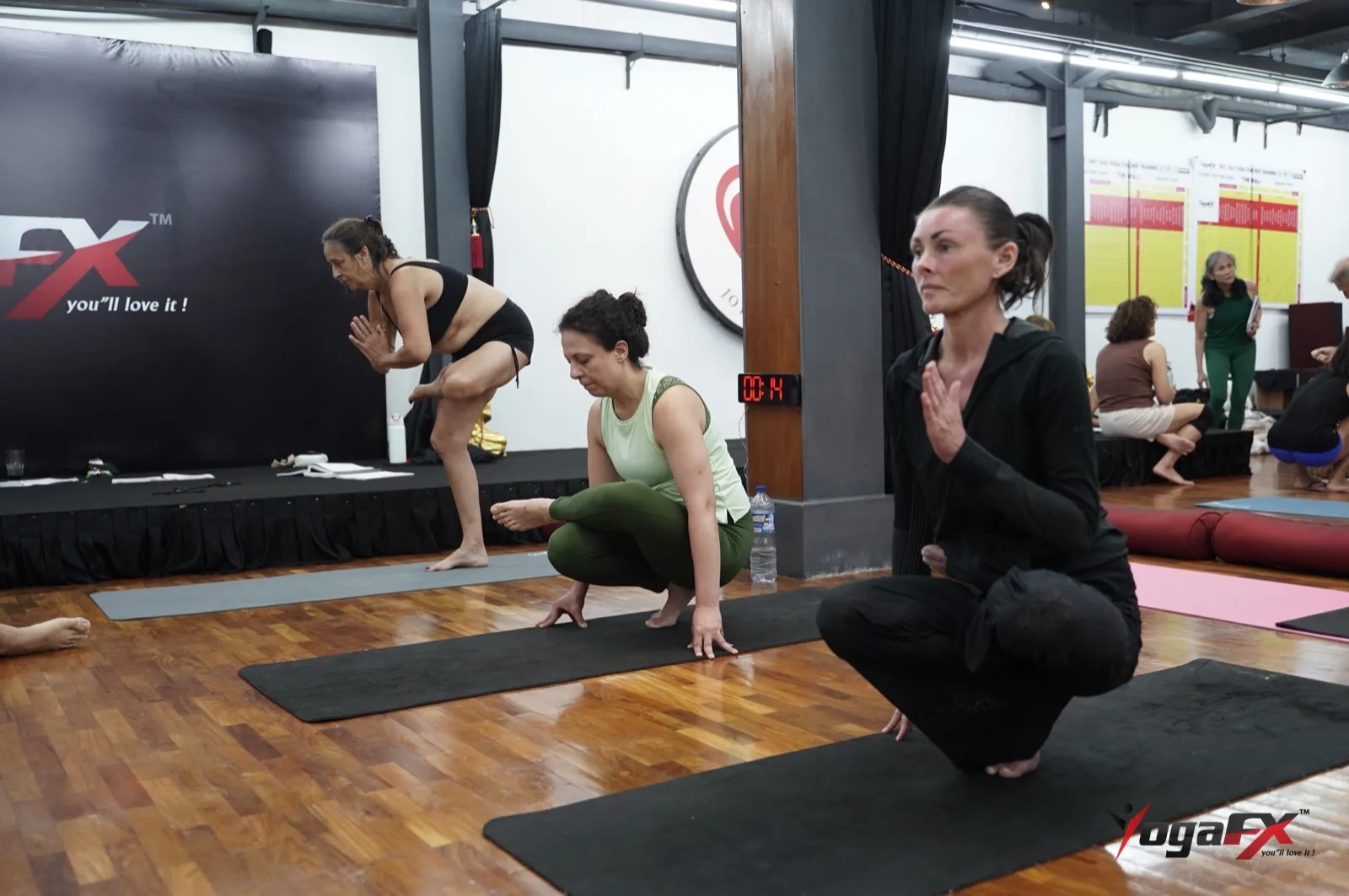
By Mr. Ian Terry, E-RYT 500, founder of YogaFX · Published
Hot yoga heart rate is easiest to judge as a share of your own maximum. Mayo Clinic describes moderate effort as 50% to about 70% of maximum and vigorous effort as 70% to about 85%. Work out your numbers once, before your first heated class, and use them to pace yourself.
This guide is written for online trainees. You study the sequence at home, then step into a heated room, and you need a calm way to pace those first classes. Your hot yoga heart rate is one simple tool. It isn't a medical test, and it doesn't replace advice from your doctor.
Below you will find a hot yoga heart rate pacing table by age, what one heated-room study measured and the warning signs that matter more than any number. You will also get a four-class plan for your first weeks.
This article is part of our Hot Yoga for Men guides.
Hot Yoga Heart Rate Basics for Online Trainees
A heart rate zone is a band of beats per minute linked to an effort level. Low effort sits close to your resting pulse. Moderate effort feels steady, and you can still speak in short sentences. Vigorous effort makes talking hard.
Heat adds a second demand on top of effort, because your body is also working to cool itself. So your hot yoga heart rate can look high even when a posture feels gentle. That is why a hot yoga heart rate reading needs a reference point, and why a new student should never judge a class by one figure.
Why trainees should learn hot yoga heart rate early
One day you will cue other people through this room. A teacher who knows her own hot yoga heart rate can say “slow down, breathe and rest” with confidence, because she has felt it first. Mr. Ian Terry, E-RYT 500, Founder and Lead Instructor at YogaFX, has taught more than 12,000 hours. The YogaFX approach is to learn your own limits before you coach anyone else’s.
If you are brand new to heat, start with our guide to preparing at home before your first class. It covers what to bring and what to expect, so this page can stay focused on the numbers.
Hot Yoga Heart Rate Zones by Age: A Pacing Table
The Mayo Clinic exercise intensity guide gives two simple ranges. Moderate exercise is 50% to about 70% of your maximum heart rate. Vigorous exercise is 70% to about 85%. For healthy people, it estimates your maximum as 208 minus 0.7 times your age.
Here is the sum in three steps:
- Multiply your age by 0.7.
- Subtract that result from 208. This is your estimated maximum.
- Multiply the maximum by 0.5, 0.7 and 0.85 to find the edges of each zone.
| Age | Estimated maximum | Moderate zone (50% to 70%) | Vigorous zone (70% to 85%) |
|---|---|---|---|
| 30 | 187 beats per minute | 94 to 131 | 131 to 159 |
| 40 | 180 beats per minute | 90 to 126 | 126 to 153 |
| 50 | 173 beats per minute | 87 to 121 | 121 to 147 |
| 60 | 166 beats per minute | 83 to 116 | 116 to 141 |
Write your two hot yoga heart rate ranges for your age on a card and keep it near your mat. A useful goal for a first class is to spend most of your time in the moderate band and treat the vigorous band as a short visit.
Treat the table with care, though. Mayo Clinic says your true maximum can sit 15 to 20 beats per minute above or below the estimate. It also notes that some medicines, including some blood pressure medicines, can lower maximum heart rate. If that applies to you, ask your doctor for your own target zone.
What a Heated-Room Study Found About Pulse and Effort
One of the few controlled studies of this question is Lambert and colleagues (2020), published in the International Journal of Exercise Science. Its title is Acute Physiologic Effects of Performing Yoga in The Heat. It is a useful anchor for hot yoga heart rate, because it measured pulse and energy use instead of guessing.
Sixteen experienced practitioners took part, 14 women and 2 men, with an average age of 40. Each one did a one-hour Bikram sequence twice, in random order and at least four days apart. One session was at 105°F and the other at 74°F, both at 40% humidity.
- Mean heart rate: 113 beats per minute in the heat and 109 in the cooler room.
- Energy use: about 156 kcal in the heat and 151 kcal at 74°F for the hour.
- Oxygen use: roughly a quarter of maximum, at 25.3% and 23.5% of VO2max.
- Verdict: the authors reported that mean oxygen use, peak oxygen use, pulse and calories did not differ between the two rooms.
Other measures did differ. The authors reported that the heated session may acutely increase hip range of motion and shift fuel use. So heat is not irrelevant. It simply did not raise the measured workload much in this group.
How far this study can take you
The limits matter for a new trainee reading any hot yoga heart rate research. The group was small and mostly women, and every person was an experienced practitioner. The authors describe the intensity as low, under 30% of VO2max, and they did not measure thermoregulation directly. The lab sessions also lasted one hour, while a YogaFX class runs 90 minutes.
So the study tells you that heat alone does not double your workload or your hot yoga heart rate for people who know the sequence. It doesn't tell you how a beginner copes. For that, you'll need your own pulse, your own symptoms and your teacher’s eyes.
For the core temperature side of the story, read our guide to hot yoga temperature. For energy figures, see how many calories hot yoga burns.
Reading Your Hot Yoga Heart Rate on the Mat Without Overthinking It
A hot yoga heart rate check should take seconds, not minutes. The aim is a quick picture, then back to your breath. A few habits keep it simple.
Use the talk test as your first check
Many teachers use a plain test. If you can speak a short sentence, you are probably in a moderate range. If you can only manage a few words, you are probably working hard. It is a teaching habit, not a laboratory measure, so pair it with your card.
Measure when you are still
Count your hot yoga heart rate at your wrist for 15 seconds and multiply by four. Do it while lying down or standing still, never mid-posture. A watch or chest strap can help, but movement, sweat and a loose strap can all distort a reading. Read the figure as a trend over the class, not a verdict.
Set your ceiling with a professional
Mayo Clinic also advises talking to a health care professional if you have any medical conditions or you are not sure how hard you should exercise. That advice fits a first heated class well, because the room adds a load that a normal gym session does not. A short conversation before you book costs little, and it can set a safer ceiling for your pulse.
Watch how fast it settles
Over several classes, one hot yoga heart rate pattern tells you more than any single number. Notice how quickly your breathing slows in the lying-down rests. If it settles faster after two or three weeks, your practice is probably getting more efficient.

When Heat, Not Effort, Is the Problem
Hot yoga heart rate zones describe effort. They do not describe heat stress. A comfortable number does not rule out trouble, which is why symptoms come first. The CDC page on heat and your health says heat can make health worse for people with a heart condition or other chronic conditions. It also lists people with heart disease as high risk.
The same page warns that many medicines can leave you dehydrated or overheated on hot days. It adds that you should not stop or change your medicines until you talk to your doctor. That advice matters for anyone who takes a daily tablet and plans to join a heated class.
The CDC lists these signs that your body is struggling with heat:
- Muscle cramping
- Unusually heavy sweating
- Shortness of breath
- Dizziness
- Headaches
- Weakness
- Nausea
If any of these appear, stop, lie down and tell your teacher, whatever your pulse says. Chest pain, fainting or confusion needs urgent medical help. Our guide to hot yoga hydration explains the water habits that go with this.
A Four-Class Ramp for Home Students Entering the Hot Room
You don't need a lab to pace your first weeks. You need a plan that lets you rest and a short log. This ramp is a general teaching idea, not a medical programme, so adjust it with your doctor and teacher.
- Class one: rest whenever you like. Check your pulse only when you are lying still, and note how you feel.
- Class two: take one extra hot yoga heart rate check halfway through. Compare it with the zones on your card.
- Class three: notice which posture makes your breath short first. Write it down.
- Class four: review your notes with a teacher and decide what to change.
Your log can be five lines long. Keep it light, and fill it in after class, not during. Don't turn it into homework.
- The date and, if you know it, the room conditions.
- The posture where your breath shortened first.
- Your hot yoga heart rate at the hardest moment and during a rest.
- How you felt the next morning.
After a few weeks, look for patterns. Does the same posture feel easier? Does your breath settle faster? If the answer is no, shorten the session, rest more or ask your doctor before pushing further. Our guide to hot yoga and your heart covers the questions to take to that appointment.
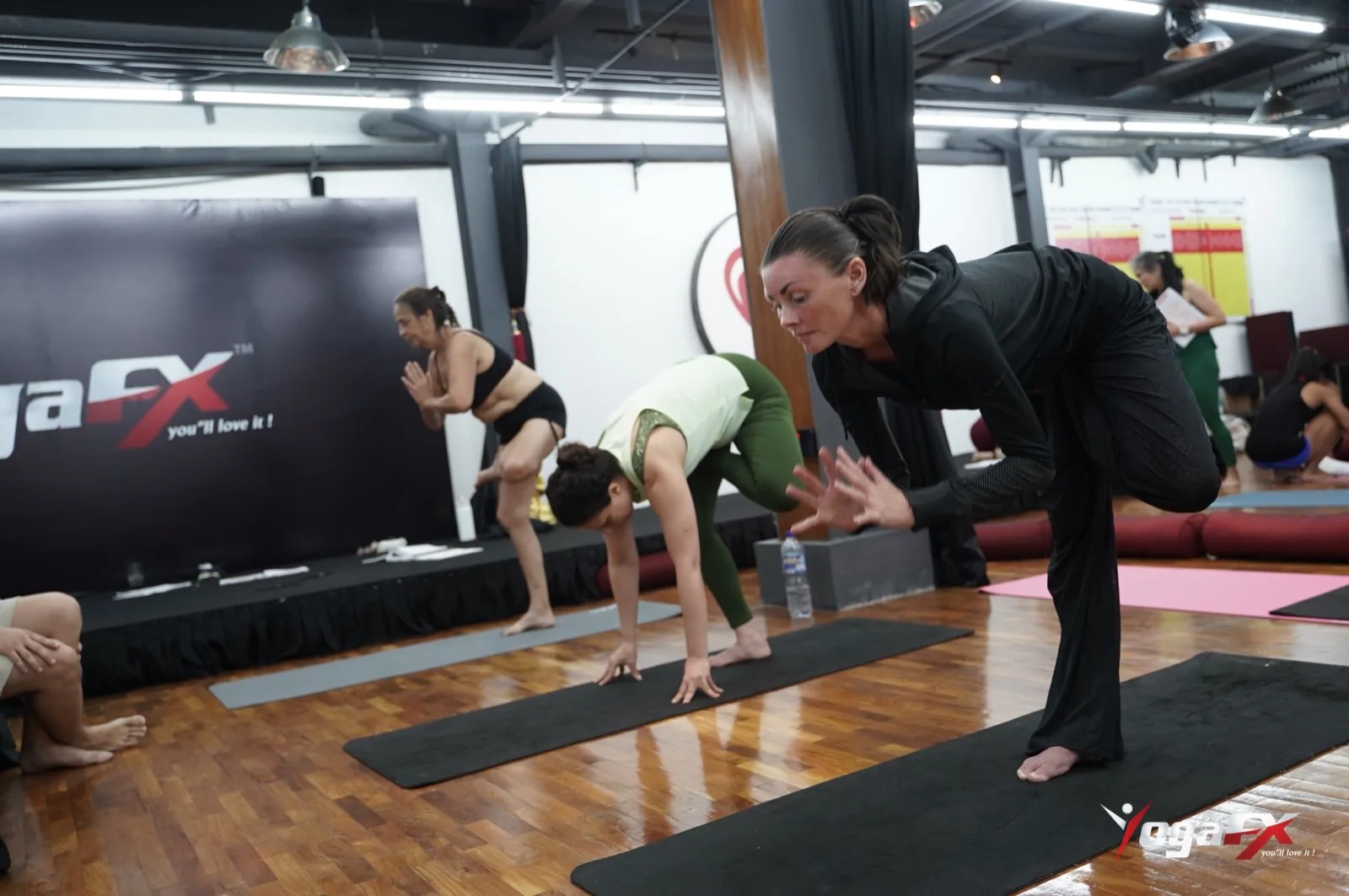
How Trainees Learn Hot Yoga Heart Rate Awareness at YogaFX
A YogaFX studio class runs for 90 minutes at 40°C (104°F) with about 40% humidity, and the heat comes from the tropical climate rather than electric heaters. Mr. Ian Terry spent five years, from 2014 to 2019, training with the founder of the Bikram Hot 26&2 method. He founded YogaFX in 2017, and more than 1,500 graduates from over 80 countries have trained since.
The class dialogue is scripted, so the pace is steady and predictable, which keeps your hot yoga heart rate easier to read. That helps a new student plan rests and breathing around it. It also frees a teacher to watch faces, colour and breath instead of inventing words.
You can learn the theory first. The online course costs USD 329, or 4 x USD 82, and our guide to hybrid yoga teacher training shows how it fits around a day job. For a second view of the same research, the team at Hot Yoga Teacher Training Online wrote a companion guide on pulse in a heated room.
Prefer to feel your own hot yoga heart rate in the room first? The Free 1-Day Guest Pass at our Seminyak studio gives you a first class at no cost. Message Mr. Ian on WhatsApp to book it.
What Trainees Say About Learning With Us
Numbers help, but confidence comes from good teaching. These reviews come from graduates, and we use first names only.
“Amazing yoga teacher training”
Nyoman, Google review, 2024
“YogaFX is amazing. The teacher training experience helped me become much more confident. Good luck everyone.”
Yayuk, Google review, 2024 (translated)
“We know that he changed our lives”
Konrad, YouTube review, 2023
FAQ: Hot Yoga Heart Rate Questions
Should I wear a monitor to track my hot yoga heart rate?
A monitor can help you spot trends, but it is optional. Sweat, movement and a loose strap can distort readings, so treat the number as a guide. Your breath, your balance and how you feel matter more. If the screen and your body disagree, trust your body and rest.
What should I do if my hot yoga heart rate feels too high?
Stop the posture, lie down on your back and breathe slowly through your nose. Tell the teacher and sip water. Rest until your breathing settles. If you feel dizzy, faint, nauseous or have chest pain, stop practising and get medical help. Never push through those signs, whatever your watch shows.
Does a higher hot yoga heart rate mean I am working harder?
Not always. In a 2020 study, experienced practitioners averaged 113 beats per minute in a heated room and 109 in a cooler one, and the authors found no significant difference. Heat can make a class feel harder without raising the measured workload much, so use effort and symptoms alongside your pulse.
How do I work out my hot yoga heart rate zones before my first class?
Subtract 0.7 times your age from 208 to estimate your maximum, as Mayo Clinic describes for healthy people. Then multiply by 0.5 and 0.7 for the moderate zone, and by 0.7 and 0.85 for the vigorous zone. Your real maximum can differ, so ask your doctor if you take medication.
Is hot yoga safe if I have a heart condition?
Ask your doctor before you book a heated class. The CDC says heat can make a heart condition worse, and many medicines can leave you dehydrated or overheated. Do not stop or change medicines on your own. Your doctor may suggest a lower effort limit, a cooler room or another activity.
Still have questions? Message Mr. Ian and the YogaFX team on WhatsApp and we will answer them personally.
This guide is general education, not medical advice. Please consult a healthcare professional before you begin or change a hot yoga routine, especially if you are pregnant, take medication or have a heart or blood pressure condition.