Hot Yoga Temperature: How Hot Is the Room You Will Teach In?

By Mr. Ian Terry, E-RYT 500, founder of YogaFX · Published
The standard hot yoga temperature in a YogaFX class is 40°C (104°F), with about 40% humidity, for all 90 minutes. A trainee needs more than that number, though. You also need to know what the heat does to a student and how to spot trouble early.
This article is part of our Bikram yoga teacher training guides.
Hot Yoga Temperature and Humidity: The Short Answer
Here is the short answer in one list. These are the room conditions every YogaFX 26&2 trainee learns to expect.
- Temperature: 40°C (104°F) is the class standard.
- Humidity: about 40%.
- Length: 90 minutes, with 26 postures and 2 breathing exercises.
- Original Bikram reference: 40.5°C (105°F), the figure people often quote as “105 degrees”.
- Other heated styles: many flow classes run lower, roughly 32°C to 38°C, according to the YogaFX guide to Hot 26&2 Yoga.
Treat every hot yoga temperature figure as a target, not a promise. A full room adds body heat and moisture, so the real number drifts a little during class. That is why a teacher watches the students, and not only the thermostat.
Not sure how this compares with a standard class? Our guide to hot yoga versus regular yoga sets the two side by side.
What a Hot Yoga Teacher Must Understand About the Room
The heat is a tool, not a test
Students often think the hot yoga temperature is there to punish them. A teacher has to say the opposite, calmly and often. The hot yoga temperature is one part of the class, alongside the postures, the breathing and the spoken dialogue.
That matters because your tone sets the mood. If you treat the hot yoga temperature as a challenge to beat, students will push too hard. If you treat it as a condition to work with, they will pace themselves.
Every body meets the same room differently
Two people can stand on neighbouring mats and feel very different. One is cheerful at minute 60. The other is grey in the face at minute 20. As a result, you cannot teach to the average student. You teach to the one who is struggling most.
New students, people returning after a break and anyone carrying extra stress usually need the most room to rest. Mr. Ian Terry, E-RYT 500, Founder and Lead Instructor at YogaFX, has taught more than 12,000 hours. His advice to trainees is simple: learn the hot yoga temperature numbers, then learn to read faces.
Bali adds its own warmth
In Bali, tropical air does a lot of the work. The class still follows the same 40°C standard, but a trainee learns that the same hot yoga temperature feels different on a humid afternoon than on a dry morning. That is a useful lesson for any teacher who plans to work in more than one climate.
How Hot Is Hot Yoga? The Briefing Every New Student Needs
Students ask how hot is hot yoga before they ask anything else. Answer with the numbers, then say what the numbers feel like. A student who hears 40°C and nothing more may picture a sauna. A student who hears 40°C, 40% humidity and “you can rest whenever you like” pictures a class.
- Say the numbers. Give the hot yoga temperature in Celsius and Fahrenheit, because students search for both.
- Say what to expect. Sweating is normal, and a towel on the mat helps.
- Say what is allowed. Sitting, lying down and sipping water are all part of class.
- Ask about health. New, pregnant or on medication? Ask students to tell you before class, and to see a doctor first if they have a heart, blood pressure or kidney condition.
Keep the briefing under a minute. Long speeches make nervous students more nervous. And if someone asks about the Bikram yoga temperature, give both figures: 40°C for a YogaFX class and 40.5°C for the original room. The half-degree gap is not what matters in class. Your attention is.

What the Research Says About Hot Yoga Temperature
The research on hot yoga temperature is small, so it is worth reading carefully. Two studies matter most for a trainee, and one clinical page explains the risk. Each one shows the limits as well as the upside.
Core temperature climbs during a class
An ACE-sponsored study by Quandt, Porcari and colleagues (2015) tracked 20 volunteers aged 28 to 67 through a 90-minute class at 105°F and 40% humidity. Core temperature was logged every 10 minutes with a swallowed sensor.
- Average highest core temperature was 103.2°F for men and 102.0°F for women.
- Seven of the 20 people went above 103°F.
- One man reached 104.1°F by the end of class.
- Heart rate averaged about 80% of predicted maximum for men and 72% for women.
Core temperature rose steadily as the class went on. That is the reason a teacher paces the second half with extra care. The article also notes that the risk of heat illness rises at about 104°F, and none of the volunteers showed signs of heat intolerance.
Does a hotter room make the workout much harder?
A 2020 crossover study by Lambert and colleagues compared a one-hour Bikram sequence at 105°F with the same sequence in a cooler room. Its title is Acute Physiologic Effects of Performing Yoga in The Heat. It used 16 experienced practitioners and held humidity at 40%.
Average heart rate was 113 beats per minute in the heat and 109 in the cooler room, which was not a significant difference. All sessions were well tolerated.
So the heat is not magic, and it is not a hidden fitness trick. It changes how the work feels and how the body has to cope with the hot yoga temperature. Both studies were small, and neither says anything about your own heart, blood pressure or medication.
Why 104°F is a line to respect
The Mayo Clinic explains that an average core temperature is about 98.6°F (37°C). It says heatstroke begins when core temperature reaches 104°F (40°C) or higher, and that this needs urgent medical attention. For a teacher, that is the number behind every decision about hot yoga temperature and pace.
Before you teach, practise saying the key figures aloud: the hot yoga temperature, the humidity and the class length. If you can say them clearly, you can answer a nervous student in seconds. That small habit builds trust before the first posture.
Reading the Room: Signs a Teacher Watches For
A teacher cannot measure each student’s core temperature. Instead, you watch behaviour, whatever the hot yoga temperature is that day. The table below pairs what you can see with why it matters and a sensible first response.
| What you see | Why it matters | A sensible first response |
|---|---|---|
| Gulping air through the mouth | The student may be working too hard for the room | Slow the pace, remind the class to breathe through the nose, offer a rest |
| Very flushed or very pale face | The body may be struggling to shed heat | Invite the student to sit or lie down and keep sipping water |
| Dizziness or faintness | Listed by the Mayo Clinic as signs of heat exhaustion | Lie the student down on the back, stop practice, stay close |
| Muscle cramps | Another listed sign of heat exhaustion | Pause the posture, ease out gently, offer water |
| Nausea or headache | Also listed by the Mayo Clinic | Rest in a cooler spot with cool water |
| Confusion or fainting | The Mayo Clinic advises immediate medical help | Call for help straight away and do not wait for class to end |
Notice that the first two rows are teaching observations, not diagnoses. Your job is to notice early and offer rest. It is never to decide what is wrong with someone.

Pacing Your Class to the Hot Yoga Room Temperature
The hot yoga temperature does not stay perfectly still. Doors open, the room fills and a humid evening feels different from a dry morning. For example, a teacher who sees the class slowing may allow a longer rest between postures.
Use the dialogue as a pacing tool
In our classes the dialogue is scripted, so the pace is steady. Steady is a safety feature. Students can predict what comes next, so they can plan their breathing and their rests around it.
Watch the back rows
Students at the back or beside a wall are easy to miss. As a trainee, practise walking the room early so you see every face, not only the front rows.
Look after your own body first
Teachers feel the heat too. Drink before class, sip during it and eat sensibly beforehand. A teacher who is dizzy cannot help anyone, so your own hydration is part of your job.
What to Do When a Student Struggles in the Heat
The Mayo Clinic gives clear first steps for heat exhaustion. A trainee should know them by heart, because the hot yoga temperature is where they apply.
- Stop all activity and let the student rest.
- Move to a cooler place, even if that only means the edge of the room or the doorway.
- Offer cool water or a sports drink.
- Watch closely. Seek medical advice if symptoms get worse or do not improve within an hour.
- Get immediate help if the student becomes confused, loses consciousness or cannot drink.
Pausing is never a failure. In fact, sitting out mid-sequence is a teacher-level skill, and we ask trainees to model it. When you rest openly, students feel allowed to do the same.
How Trainees Learn to Teach in Heat at YogaFX
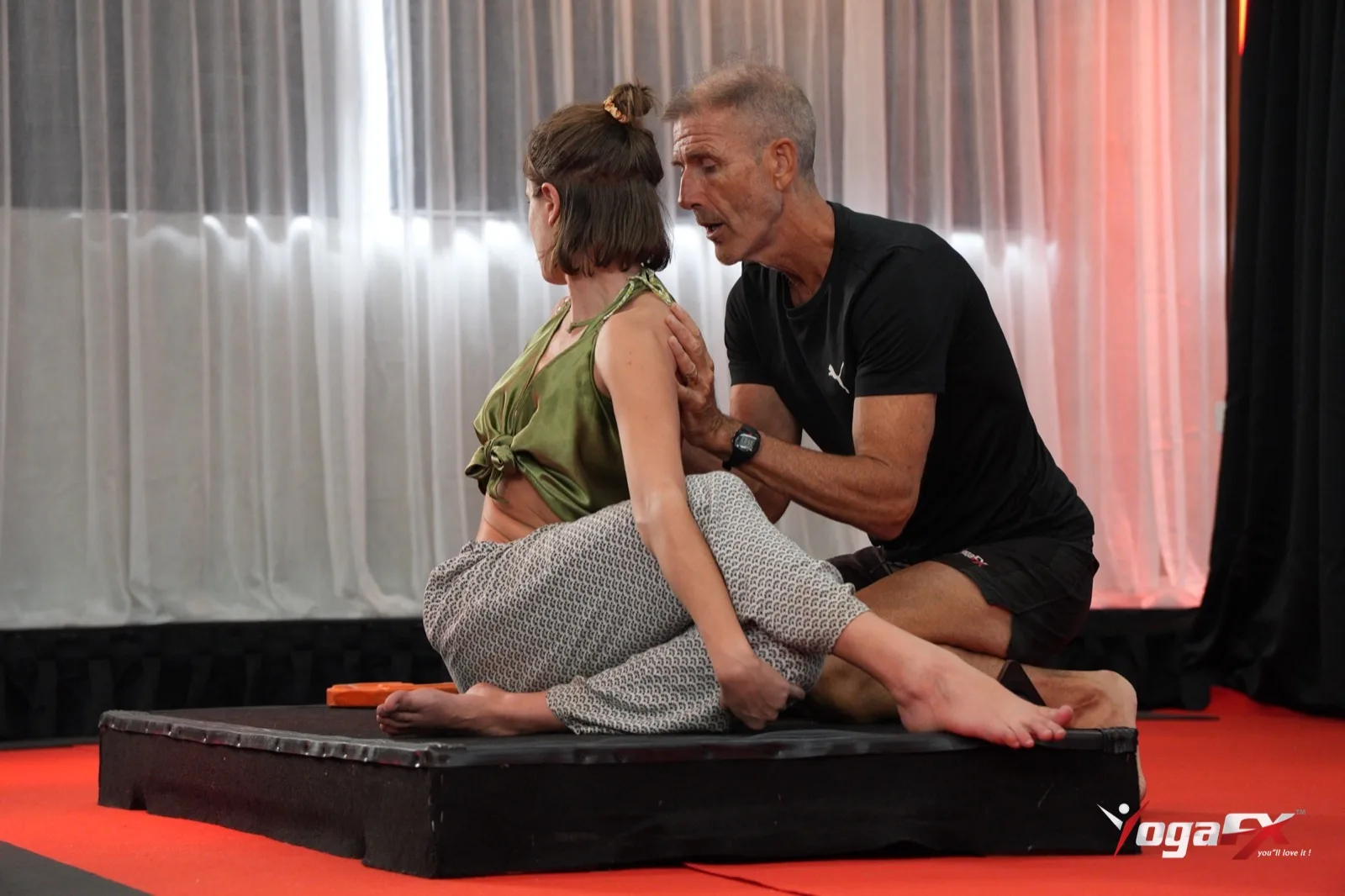
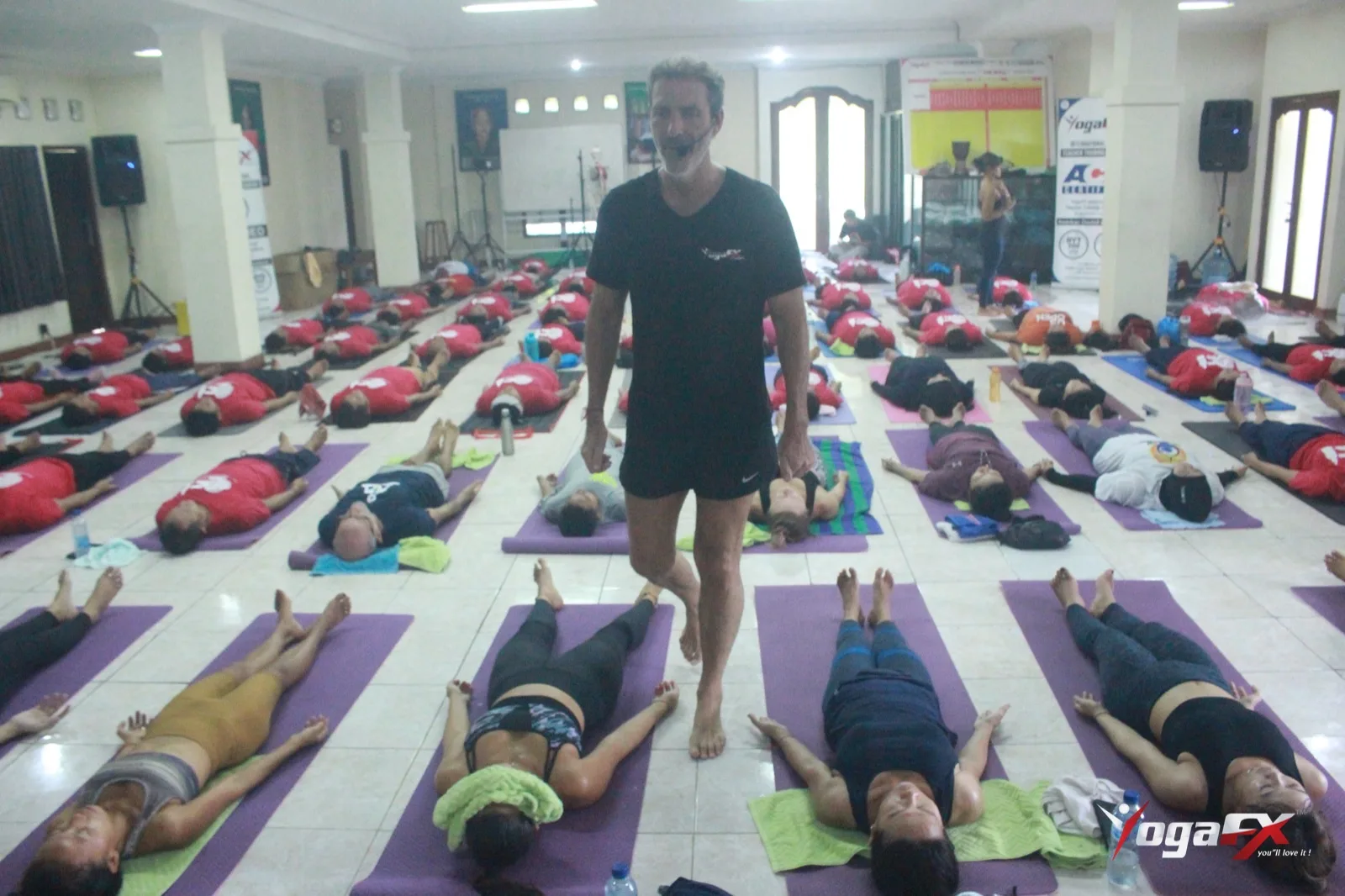
Mr. Ian Terry spent five years, from 2014 to 2019, training with the founder of the Bikram Hot 26&2 method. He founded YogaFX in 2017 and teaches the scripted dialogue word for word. That structure is practical, especially when the hot yoga temperature shifts during class. When you do not have to invent your words, your attention is free for the students’ faces, skin colour and breathing.
In a teacher training, that means three habits:
- Check the room early. Look at breathing and colour in the first part of class, before anyone is in trouble.
- Keep water within reach. Remind students to sip before thirst, not after it.
- Say rest is allowed. Students rarely stop unless the teacher gives permission first.
Want to see the same room explained for students rather than teachers? This piece shows how the room works from a student’s side.
Studying the Heat From Home Before You Fly to Bali
You do not need a heated room to start learning about hot yoga temperature. The online course costs USD 329, or 4 x USD 82, and it lets you study the dialogue, the posture order and the safety basics from your living room. Our guide to hybrid yoga teacher training explains how the online part fits around a day job.
Two other pages help while you study. What is hot yoga covers the basics for newcomers, and original hot yoga at home explains what you can and cannot recreate without a heated room.
Because the online course teaches the theory first, you arrive in Bali already knowing what to watch for. That frees you to focus on feeling the room, which no video can fully teach.
Prefer to feel the heat first? The Free 1-Day Guest Pass at our Seminyak studio gives you a first class at no cost. Message Mr. Ian on WhatsApp to book it.
What Our Trainees Say About Their Teacher
Heat is easier to face when the person guiding you is supportive. These Google reviews come from graduates, and we use first names only.
“He is a great communicator and has been extremely supportive of my commitment to becoming an amazing yoga teacher.”
Jade, Google review, 2021
“Mr. Ian is a very talented and gifted teacher. Not only he teaches yoga postures, but he provides a lot of life coaching experiences.”
Ebtesam, Google review, 2022
“It's more than just a class it's a family with a very great teacher.”
Amalia, Google review, 2020
FAQ
What temperature is hot yoga done at?
The hot yoga temperature usually runs between about 32°C and 40.5°C, depending on the style. In a YogaFX 26&2 class the standard is 40°C (104°F) with about 40% humidity for 90 minutes. Studios set their own targets, so ask any studio for its numbers before you book.
How hot is Bikram yoga?
The original Bikram room is quoted at 40.5°C (105°F) with about 40% humidity, and a class lasts 90 minutes. A YogaFX class uses a standard of 40°C (104°F). The one-degree gap is small, but the full class still asks your body to work hard in the heat.
Is hot yoga too hot for beginners?
The hot yoga temperature can feel intense at first, so beginners should go gently. Sit out whenever you need to, sip water, and breathe through your nose. Check with a healthcare professional first if you have a heart, blood pressure or kidney condition, or if you are pregnant. A good teacher expects new students to rest.
Does hot yoga raise core body temperature?
Yes, it can, at the usual hot yoga temperature. In an ACE-sponsored study of 20 regular practitioners, average highest core temperature reached 103.2°F in men and 102.0°F in women during a 90-minute class at 105°F. One man reached 104.1°F, so pacing, water and rest matter for every student.
What should I do if I feel dizzy in a hot yoga class?
Stop practising, lie down on your back and tell the teacher. The Mayo Clinic advises that heat exhaustion calls for stopping activity, moving somewhere cooler and drinking cool water or sports drinks. Get medical help right away if you feel confused, faint or cannot drink.
Still have questions? Message Mr. Ian and the YogaFX team on WhatsApp and we will answer them personally.
This guide is general education, not medical advice. Please consult a healthcare professional before you begin or change a hot yoga routine, especially if you are pregnant or have a heart, blood pressure or kidney condition.