Original Hot Yoga at Home: Can You Practise the Sequence Without a Heated Room?
Original hot yoga at home is possible without a heated room, but it works as a rehearsal, not a replacement. For a routine that fits a full-time job, see hot yoga for men who work full time. You can practise the same 26 postures and 2 breathing exercises on a cool floor if you warm up first and keep the session short. What you cannot do is copy the 40°C class.
This guide is for the busy person who wants the original hot yoga sequence in their week when the studio is out of reach. Maybe you’ve a long commute, a sleeping baby, a month of travel or no hot room in town. It follows the teaching of Mr. Ian Terry, an E-RYT 500 teacher with 12,000+ teaching hours, who teaches the sequence as one fixed script.
If you want to see how studios label this class on a timetable, read this UK guide to what the original hot yoga label promises. This page asks a different question: what happens to the class when you take it out of the heat?
Original Hot Yoga at Home: What You Keep and What You Lose
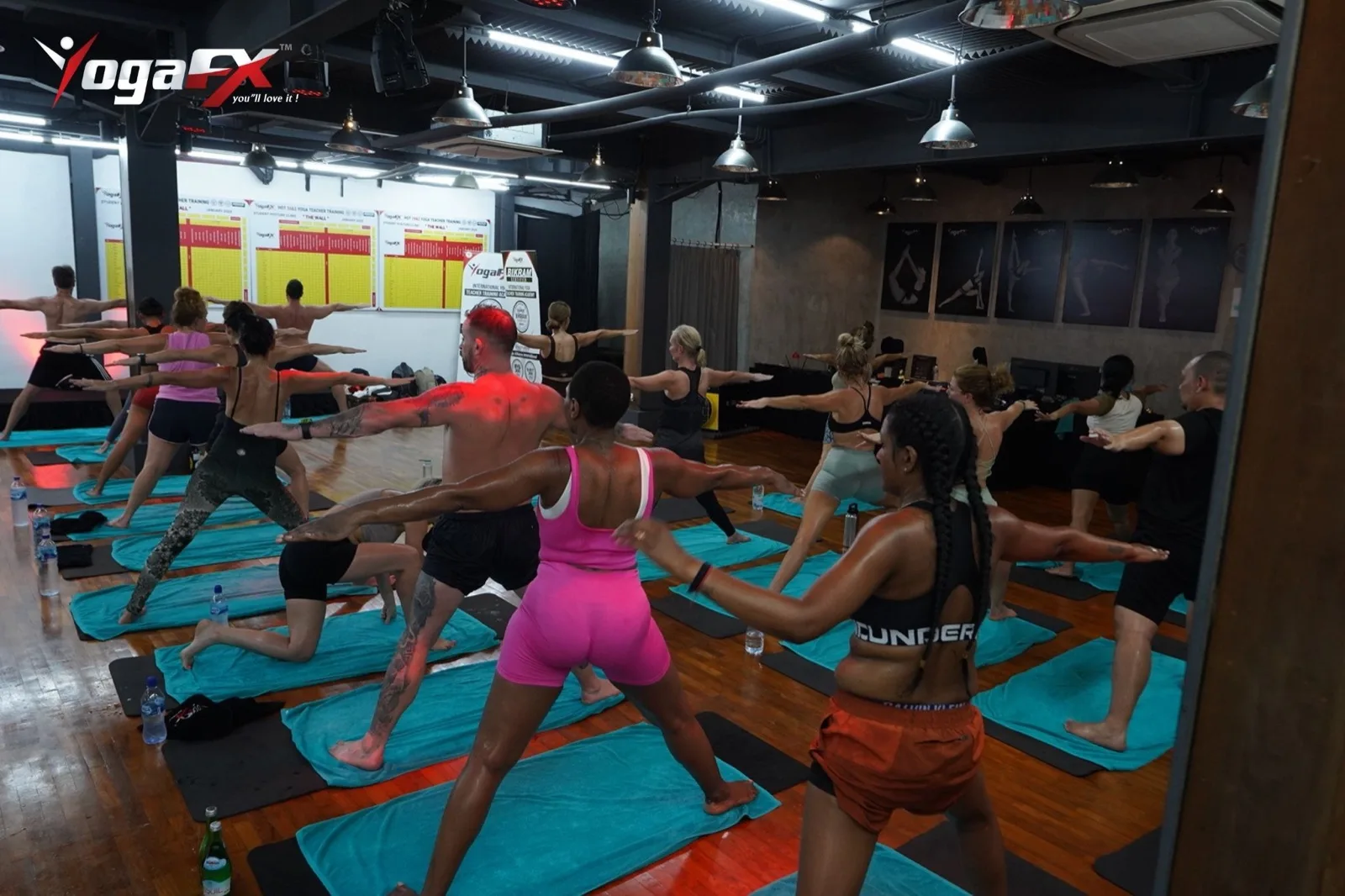
A full original hot yoga class has five fixed parts. It has the same 26 postures and 2 breathing exercises, always in the same order. It lasts 90 minutes. The room sits at about 40°C with 40% humidity. And the teacher speaks a scripted dialogue, with no music and no demonstration.
At home you can keep the first part and, with effort, the last. The room, the group and the teacher’s eyes stay in the studio. That split decides everything else about original hot yoga at home, because the postures travel with you and the heat doesn’t.
What travels home with you
- The order. Original hot yoga runs a standing series first, then a floor series. You can rehearse any slice of it in the same sequence.
- The postures and breathing. Standing deep breathing (Pranayama) needs only a little floor space and a quiet minute.
- The cues. The dialogue is the same every class, so you can learn the words and say them softly to yourself.
What stays in the studio
- The heat and humidity. A normal room will not warm your muscles for you, so you must do that job yourself.
- The rhythm of the group. In class, ten other people keep you moving. At home, only you do.
- A second pair of eyes. A teacher catches a locked knee before it hurts. Alone, you have to feel it first.
The numbers below show how far apart the two settings sit. Three of them you can bring home. Two of them describe the room you are training toward.
Five Honest Rules for Original Hot Yoga Without the Heat
These rules come from a simple fact. A hot room does part of your warm-up for you, and a cool room doesn’t. Everything about original hot yoga at home follows from that. Everything below is about covering that gap safely.
1. Warm up before you stretch anything
Mayo Clinic’s stretching guidance says stretching cold muscles can hurt you. It suggests five to ten minutes of light walking, jogging or low-intensity cycling first. In the studio, the room heats you. At home, a brisk walk round the block does the same job.
2. Make it shorter than the class
A 90-minute original hot yoga class is built around the heat and a teacher’s pacing. Alone and cool, aim for 20 to 30 minutes. Short sessions are easier to repeat, and repeating is what changes your body. So three short sessions beat one heroic one.
3. Do not fake the heat
Don’t close the windows, run a space heater or pull on extra layers to copy the class. The studio room is managed, and a teacher watches the room. At home, nobody does. If you feel dizzy, sick or headachy, stop, sit down and drink water. Heat without supervision is the quickest way to turn a good habit into a bad day.
4. Keep the order, even if you do less
The value of original hot yoga is its order. So don’t cherry-pick your favourite postures and skip the rest. Pick the first few postures of the standing series and do them in order. Next week, add one more. That is how the class gets built in your body.
5. Stop at pain, not at tension
Expect a feeling of tension in a stretch. Pain means you have gone too far. Cold muscles protect themselves, so you will reach less range than in class. That is normal. Chase calm, steady breathing instead of depth, and the range will come over weeks.
Original Hot Yoga at Home vs the Studio: Side by Side
Use this table to decide what to copy and what to leave for the studio. It compares the same six parts of the practice in both settings.
| Part of the class | In the studio | At home | What to do |
|---|---|---|---|
| Postures and order | 26 postures and 2 breathing exercises, fixed order | The same, if you choose to keep it | Do fewer postures, never a different order |
| Room | About 40°C, 40% humidity | Normal room temperature | Walk for 5 to 10 minutes first |
| Length | 90 minutes | 20 to 30 minutes to start | Add time slowly over several weeks |
| Guidance | Spoken dialogue, teacher watches the room | Self-guided | Learn the cues and film one posture to check your shape |
| Water and rest | Water close, rest between postures | The same | Keep a bottle on the mat and sit when you need to |
| Effort | Heat adds load and a steady pace | Lower load, easier to push too far | Stay at tension, never pain |
Read the right-hand column first. It is where most home practice goes wrong. People copy the postures and forget the safety that the room supplied for free.
A Home Plan in Three Steps
Here is a gentle path from a living-room mat to a studio class in original hot yoga. It suits a beginner, and it suits an old hand who has been away. Give each step a few weeks before you move on.
Step 1: Learn the shapes (about 20 minutes)
- Walk for five minutes, then do ten slow breaths of standing deep breathing.
- Add chair pose (Utkatasana) and eagle pose (Garudasana) for a few calm breaths each.
- Finish with cobra (Bhujangasana) and a minute of floor rest (Savasana).
- Practise three days a week, with at least one full rest day.
For a seven-posture routine built for men starting out, see our guide to hot yoga poses for men to practise at home. A towel, a mat and a water bottle are all you need, and our hot yoga mat and towel guide shows how to set up the space.
Step 2: Link them in order (about 30 minutes)
- Start with standing deep breathing, then move through the standing postures in their class order.
- Hold each one for a shorter time than you would in class, and rest between them.
- Say the cues quietly as you go. The words keep your pace steady.
- Film one posture from the side every week. Compare it with the cue, not with someone else.
Step 3: Test it in the heat
When Step 2 feels easy, take your home work into a real original hot yoga class. Tell the teacher it is your first heated class, and stay near the back so you can rest. Expect the heat to feel different from anything at home. That surprise is normal, and it is why the studio stays part of the plan.
If you want to understand how a scripted class differs from a flow class when you learn alone, our comparison of hot vinyasa and Bikram explains why a fixed script is easier to study.
What the Research Says About Heat, and What It Does Not
Heat is the first thing people worry about losing from original hot yoga. So it helps to ask what the research actually shows about it.
A 2025 systematic review in Sports Medicine - Open (Willmott et al.) pooled 43 studies and 942 participants. It found that one hot yoga session raised body temperature and heart rate, but not the energy demands compared with non-heated yoga. The authors called the claim that hot yoga beats other yoga for health “unsubstantiated” and noted case reports of ill-health after hot sessions.
A six-week trial of 290 healthy adults new to yoga (Hui et al., 2022, Psychosocial Intervention) found better life satisfaction, general health, mindfulness and peace of mind in the hot yoga group. The comparison group did no yoga at all. So the study cannot tell us whether heat itself mattered.
The best-known trial comes from Massachusetts General Hospital. The Harvard Gazette reported that 59% of adults in the heated yoga group halved their depression symptoms over eight weeks, against 6% on a waitlist. The team saw no serious adverse effects. They also said future work should compare heated with non-heated yoga.
Put together, the studies suggest that regular practice looks promising, while the role of heat is still an open question. That’s good news for home practice, because consistency counts. It isn’t a reason to promise results. These trials did not test a cool living room, and they do not replace advice from your doctor.
Please speak to a healthcare professional before you start if you are pregnant or have a heart condition, high blood pressure or a history of fainting in the heat. This page is general information, not medical advice.
Why a Fixed Script Makes Home Practice Easier
Most yoga styles change from class to class, so there’s nothing fixed to rehearse. Original hot yoga is different. The same postures come in the same order with the same cues, every time. That repetition is a gift when you practise alone, because you’ll only learn it once.
Mr. Ian Terry trained in original hot yoga for five years, from 2014 to 2019, with the founder of the method. He has taught more than 12,000 hours and graduated 1,500+ trainees from 80+ countries. He teaches the dialogue as a script, which is why a student in Bali and a student at home are working from the same words.
The class has also gone by other names over the years, such as Bikram, Hot 26 and 26 and 2. Whatever the label on the timetable, the postures behind the name don’t change.
What YogaFX Students Say About Practising Consistently
Students rarely talk about one perfect original hot yoga class. They talk about showing up, again and again. Here are two voices from people who trained with YogaFX.
Olga, who spent a week at our Bali school, wrote this Google review in 2025.
“The classes were intense but rewarding … consistent practice improved my flexibility, stamina, and mental clarity.”
Olga, Google review, 2025
Helen spoke on camera at her January 2024 graduation. In her words (paraphrased), the training changed her life, and the group she trained with felt like family. You can watch her graduation below.
Helen, YouTube review, 2024 (paraphrased). Students have left 150 Google reviews, 50 Yoga Alliance reviews and 357 YouTube testimonials so far.
From Your Living Room to the Bali Studio
Some people who practise original hot yoga at home find that they want to go further and teach. YogaFX built a path that fits a working life. The first part happens online, at home, and the last part is an intensive in Bali with real students.
The Bikram Hot 26&2 Yoga Teacher Training MasterClass is a six-day hybrid course. The next batch runs from Sunday 24 January to Friday 29 January 2027 at Soham Wellness Center in Seminyak. Graduates earn a Yoga Alliance RYT 200-Hour certificate and a Bikram Hot 26&2 200-Hour International Yoga Certification.
- Price. The Early Bird price is US$1,899, against the normal US$1,999.
- Instalments. Interest-free plans start from US$250 a month.
- Studios. The YogaFX studios in Seminyak and Canggu open 06:00 to 22:00 every day and use natural tropical heat of about 40°C.
To see what the RYT 200 credential means for a working adult, read what RYT 200 means and how to earn it around a job. Or start on the online Bikram teacher training page to see how the course fits your week.
FAQ: Original Hot Yoga at Home
Can you practise original hot yoga at home without heat?
Yes, but treat it as a rehearsal. Warm up for five to ten minutes, keep sessions to about 20 or 30 minutes, and keep the postures in their class order. Do not try to copy the studio heat with heaters or extra layers. Stop if you feel dizzy or sick.
What temperature is original hot yoga?
A studio class aims for about 40°C with around 40% humidity, for 90 minutes. The YogaFX studios in Seminyak and Canggu use natural tropical heat rather than electric heaters. A home room will be far cooler, which is why a longer warm-up and a shorter session are wise.
How long does it take to get used to hot yoga?
It varies from person to person. Many beginners feel the heat most in the first few classes, then settle as the routine becomes familiar. Rest whenever you need to, drink water through the day and tell the teacher it is your first class. Home practice can make the postures feel familiar before you start.
What are the benefits of original hot yoga?
Research on heated yoga is promising but still early. Reviews report gains in flexibility, balance and well-being, yet they also say claims that heat beats other yoga are unproven. Benefits come from regular practice. It is not a medical treatment, so keep your doctor involved if you have a health condition.
Is it safe to practise at home with a heart condition or high blood pressure?
Not automatically. Effort raises heart rate and blood pressure even in a cool room, and a heated room adds more load. Speak to your doctor first and share your plan. This article is general information, not medical advice, so personal guidance always comes first.
Still have questions? Message Mr. Ian and the YogaFX team on WhatsApp and we will answer them personally.