Hot Vinyasa vs Bikram: Which Is Easier to Learn and Teach Online?
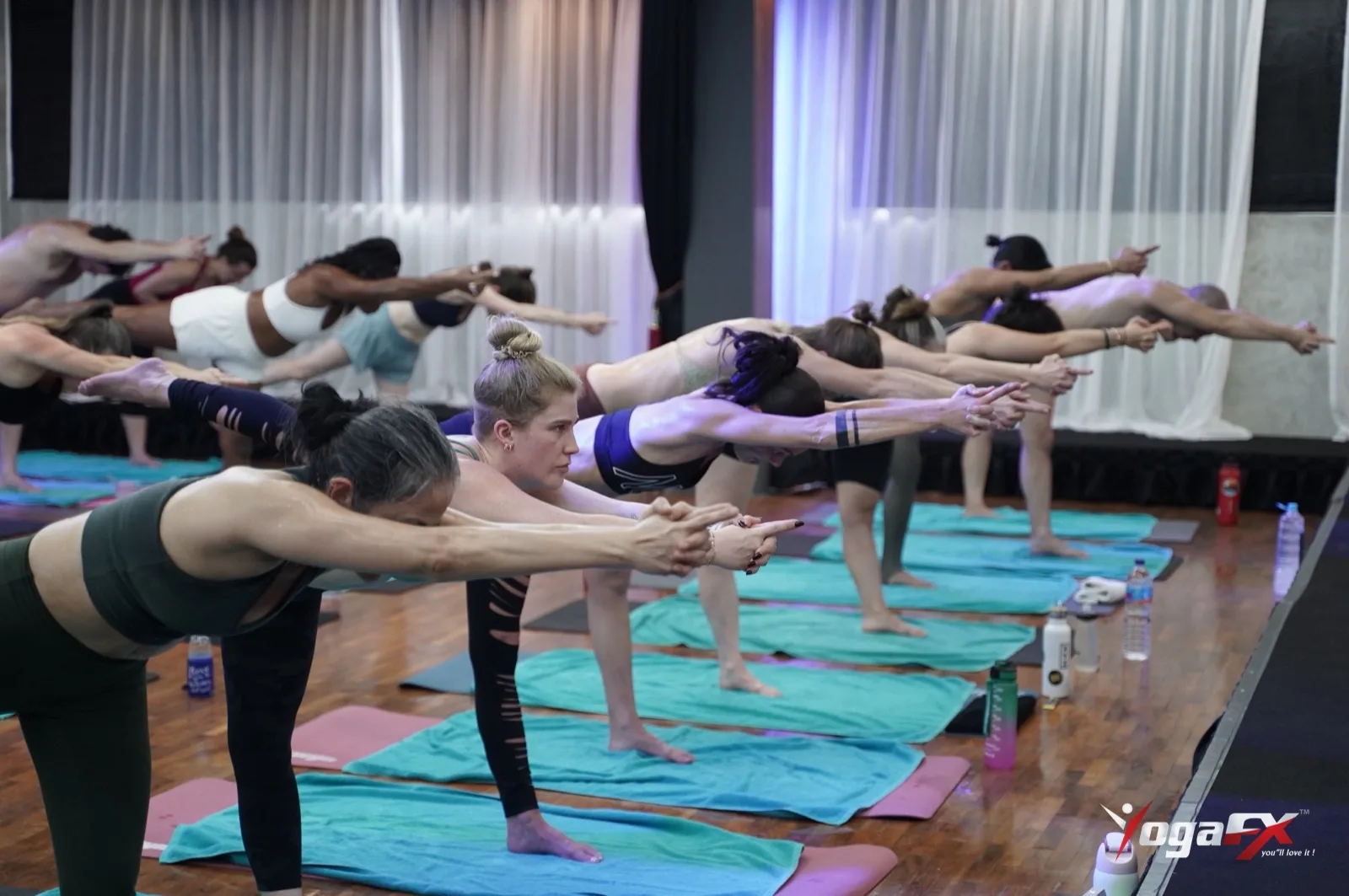
Hot vinyasa vs Bikram, or hot yoga vs Bikram yoga as most people search it, is easiest to settle online by asking which one comes with a script. The Original Hot 26&2 is the same 26 postures and 2 breathing exercises, in the same order, every class, so you can learn it from a dialogue and a video. Hot vinyasa changes each time, so it needs a teacher in the room.
This guide is written for people who study and train around a job, a family or a long commute. It draws on the teaching of Mr. Ian Terry, an E-RYT 500 teacher with 12,000+ teaching hours. We compare the two styles on one question only: which is easier to learn, and later to teach, when you are doing it online?
If you want the fitness and research side of the comparison, our sister site has a full data-led look at flowing heat against the fixed 26&2. Here, we stay with learning and teaching.
Hot Vinyasa vs Bikram: The Short Answer for Online Learners
For most people studying alone, the 26&2 is the easier side of hot vinyasa vs Bikram to learn online. The reason is structure, not toughness. A fixed order means every class you watch is a rehearsal for the next one.
That said, hot vinyasa vs Bikram is not a contest with one winner. Each style rewards a different kind of learner, and the list below shows where each one fits.
- Choose the 26&2 to learn online if you like a clear list, spoken instructions and a benchmark you can repeat at home.
- Choose hot vinyasa if you already know your way around yoga shapes and enjoy a fresh class every time, with a live teacher to guide you.
- Choose the 26&2 to teach if you want one script to master instead of a new sequence to design for every class.
You will also meet hot yoga sculpt and hot power classes on most timetables. The hot yoga vs hot power yoga question is really another flow question, and so is hot 26 vs hot flow: one side has a script, and the other side is built fresh each time. Keep that in mind, because hot vinyasa vs Bikram works the same way, and the answer stays the same.
The sections below test that answer against five practical checks. After that, we look at the research, a four-week home plan, and the route from home practice to a teaching certificate.
Hot Yoga vs Bikram Yoga: 5 Checks for Which Is Easier to Learn Online
Online learning removes the teacher's eyes and hands from your practice. So the style you pick should still make sense when nobody is correcting you. This table scores hot vinyasa vs Bikram on the five things that decide that.
| Online learning check | Hot vinyasa | Original Hot 26&2 | Easier to learn alone |
|---|---|---|---|
| Can you follow it without a demonstration? | Usually no. Teachers show or cue new links between poses each class. | Yes. The teacher speaks every instruction, with no demonstration. | 26&2 |
| Can you write the whole class on one card? | No. The order changes with the teacher and the day. | Yes. 26 postures and 2 breathing exercises, in one fixed order. | 26&2 |
| Do you need music or a playlist? | Often yes. Music sets the pace of the flow. | No. There is no music, and the voice sets the pace. | Tie, a matter of taste |
| Does it work in a normal room at home? | Yes. Warm flows work at room temperature. | Yes, as a short, unheated session. The 40°C room belongs to a proper class. | Hot vinyasa for pace, 26&2 for order |
| Is there a clear next step to teaching? | You design your own sequences, so you need a mentor. | You learn one scripted dialogue and are marked on delivery. | 26&2 |
Check 1: Hot vinyasa vs Bikram without a demonstration
In a 26&2 class, the teacher says everything aloud and does not demonstrate. That sounds strange until you try it from a video. Because the words carry the whole class, you can follow along on a laptop and lose nothing.
A flow class leans on the teacher's body. You watch a transition, copy it, and look up again at the next one. On a small screen, that gets tiring fast.
Check 2: Hot vinyasa vs Bikram when you must repeat it
Repetition is how a home student learns. When the order never moves, you stop thinking about what comes next and start noticing how each posture feels. Over a few weeks, the same forward fold changes, and you can see it.
Hot vinyasa gives you variety instead. That keeps some people interested for years. Yet when you are learning alone, a class that changes every time makes it hard to tell whether you improved or just had an easier day.
Check 3: Does the room matter at home?
Neither style needs a heated room to start. For the 26&2, practise a short, unheated version at home and keep the effort moderate. Then add the heat later, in a real class, once the order feels familiar.
Do not try to heat your living room to 40°C. It adds strain without a teacher watching, and that is not worth the risk. Our guide to hot yoga poses to practise at home shows which shapes translate best.
Check 4: How hard is the class to teach?
Teaching hot vinyasa vs Bikram means two different jobs. A flow teacher builds a fresh sequence for each class. That is creative work, and it takes years to do safely in a warm room. A 26&2 teacher learns one dialogue and delivers it with care.
So the hot vinyasa vs Bikram question changes. Instead of asking what to teach, you ask how well you can say it. Memory, voice and timing become the skills you train.
Check 5: Is there a clear path to a certificate?
In the hot vinyasa vs Bikram race to a certificate, the 26&2 leads. A fixed script gives an online course something solid to teach and to mark. You can study the dialogue at home, then finish with a short teaching intensive.
Our guide to online yoga teacher certification explains how that works and what to look for in a school.
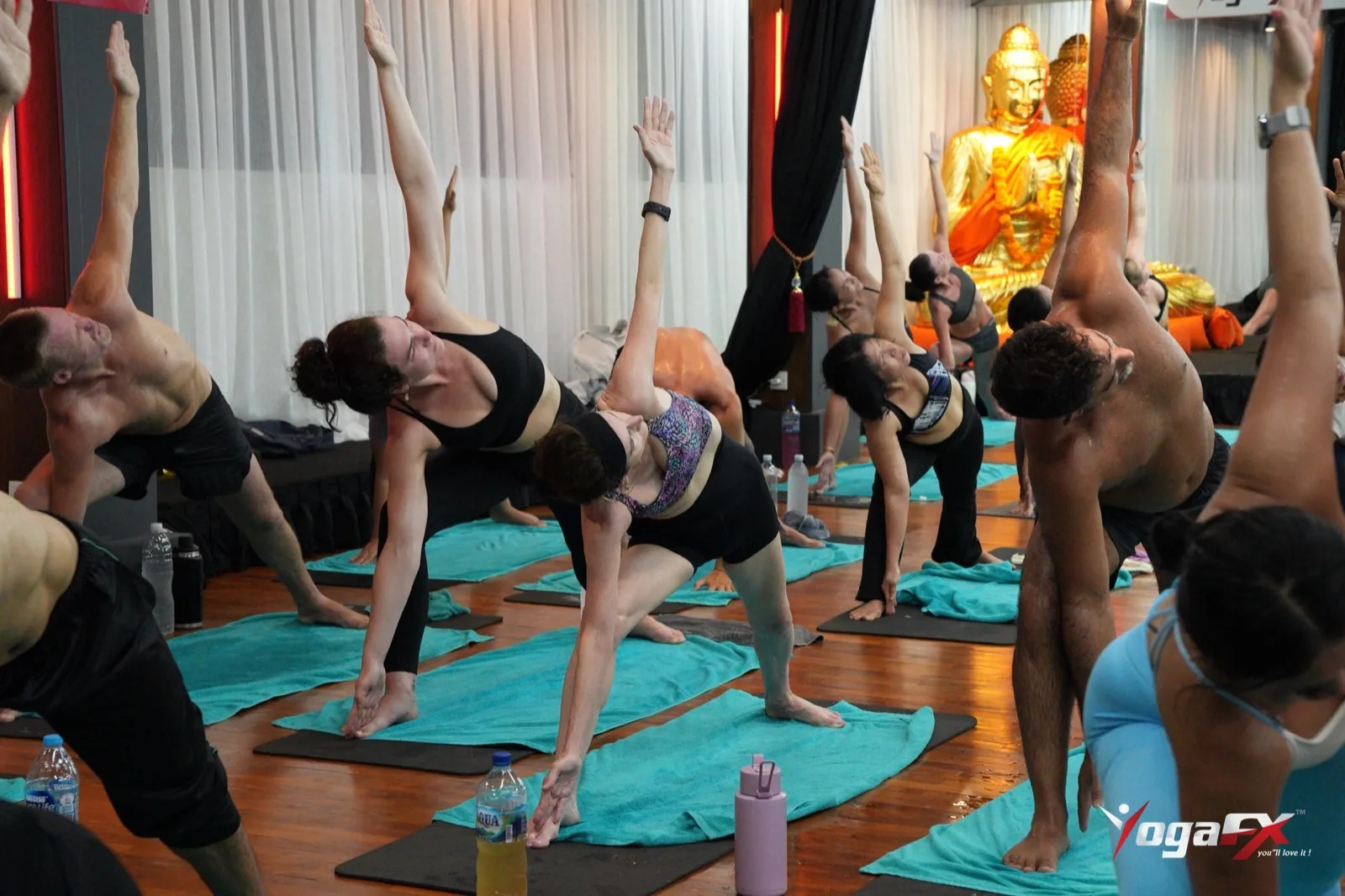
Hot Vinyasa vs Bikram in Five Numbers
Five figures sum up hot vinyasa vs Bikram for online study and why the fixed format suits it. Each one comes from a named source or from the YogaFX class standard.
What the Research Can and Cannot Tell You
Research on heated yoga is real but modest, and it rarely compares styles head to head. So take each result below as a limited finding, not a verdict on hot vinyasa vs Bikram, and read the hot vinyasa vs Bikram claims you meet online with the same care.
Mood and mental health
A 2023 trial led by Maren Nyer at Massachusetts General Hospital, reported in the Journal of Clinical Psychiatry, tested heated yoga in adults with depression. After eight weeks, 59.3% of the yoga group had their symptoms fall by half or more, against 6.3% of the waitlist group.
The result is promising for hot vinyasa vs Bikram fans of heated classes, though the trial was small. It is not a substitute for care, so please talk to a healthcare professional about any health condition.
Strength and flexibility
In 2013, Tracy and Hart reported that regular 26&2 classes increased posterior chain strength by about 20%, with gains in flexibility and body composition. That is useful if you want a practice with a clear physical payoff. It says nothing about whether flow classes do the same, because they were not measured.
The state of the evidence
A 2025 systematic review by Willmott and colleagues pooled 43 studies and 942 participants on hot yoga. We are cautious about claims of superiority too. Fixed protocols are simply easier to repeat and compare, which helps researchers and home learners alike.
We opened these papers' pages but could not read all of them, because the sites blocked us. So we name the studies here and link only what we could check. According to the CDC National Center for Health Statistics, 10.3% of US men practised yoga in 2022, against 23.3% of women. If you are new, you are in good company.
A Four-Week Home Plan to Learn the 26&2
Here is a simple way to use the fixed order, whichever side of hot vinyasa vs Bikram you lean toward. The plan is unheated and gentle, and you should shorten any session on a hard day.
| Week | Focus | Home practice | How you check progress |
|---|---|---|---|
| 1 | Breathing and standing shapes | 10 to 15 minutes, three days, standing breathing and chair pose | You can name the first three shapes without notes |
| 2 | Add balance work | 15 to 20 minutes, three days, add tree and eagle arms | You hold each balance shape, even on one side |
| 3 | Floor series | 15 to 20 minutes, three days, add cobra and locust | You remember the order from standing to floor |
| 4 | Run the full order | 20 minutes, two days, full list at an easy effort | You finish without checking your card |
Notice that every week repeats the week before it and adds one idea. That is the quiet benefit of a fixed order. A flow class cannot be learned this way, because next week's class will not match this one. That is why hot vinyasa vs Bikram feels so different at home.
Four rules that keep home practice safe
- Stop at sharp pain. A stretch should feel strong, never stabbing.
- Keep your knees soft. Bent knees protect a tight lower back in forward folds.
- Skip it when unwell. Fever, dizziness or an injury flare-up means rest.
- Drink water. Sip before and after, even in a cool room.
If you are over 40, take medication, or have a heart or blood pressure condition, check with a healthcare professional first. Go slowly, because the aim is a habit, not a record.
Teaching: Why a Fixed Script Is Easier to Hand On
Teaching is where hot vinyasa vs Bikram differs most. A flow teacher is also a choreographer. Each class needs a plan, a playlist, and a safe way to build intensity in a warm room.
The 26&2 teacher has the plan already. The job is to deliver the dialogue with clear words, steady timing and a good eye for the room. That is a skill a trainee can rehearse alone, record, and improve.
- Memory. You learn one dialogue, in order, and practise it aloud.
- Voice. You train pace, volume and calm, because nothing else carries the class.
- Timing. You learn how long each posture takes, so a 90-minute class runs on time.
- Reading the room. You watch breath and balance, and you adjust your words, not the sequence.
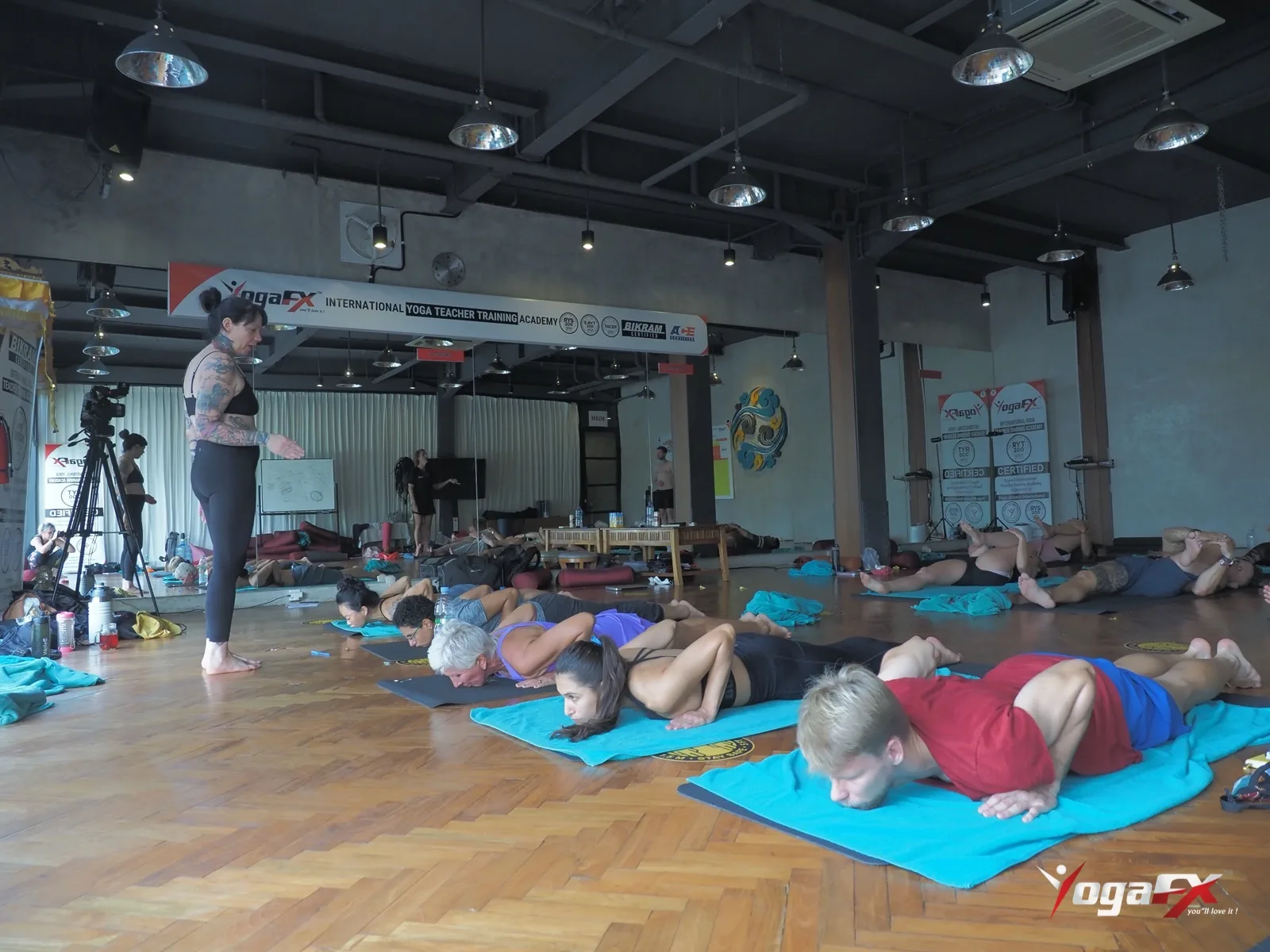
Online study covers the dialogue well. A hands-on intensive then adds what a screen cannot: live correction and a real room. To see how a Registered Yoga School fits in, read what Yoga Alliance says about how schools earn their credentials. Our explainer on what RYT 200 means shows how that credential reads on a CV.
Hot Vinyasa vs Bikram: Which Should You Choose?
Put the checks together and a clear pattern appears. The right pick in hot vinyasa vs Bikram depends on how you learn and what you want next.
- You study alone, in short blocks. The 26&2 wins, because the order is fixed and the words carry the class.
- You love variety and live classes. Hot vinyasa fits, and a studio teacher is part of the appeal.
- You want to teach hot yoga. The 26&2 gives you one dialogue to master, then a certificate to show for it.
- You want both. Use the 26&2 as your weekly benchmark, and add one flow class for fun.
Hot vinyasa vs Bikram, in one line: choose the style you can repeat, and the one that has a script if you plan to teach. Whichever way you lean, build the habit first. A short session you repeat beats a long one you skip. For a wider comparison of styles, see our note on hot yoga vs Pilates.
From Home Practice to Teaching With YogaFX
YogaFX teaches the Original Hot 26&2 Yoga in natural tropical heat in Seminyak and Canggu, Bali. Mr. Ian trained for five years, from 2014 to 2019, with the founder of the method. He is also a Master Trainer of the Republic of Indonesia Yogasana Sports Federation.
The Bikram Hot 26&2 Yoga Teacher Training MasterClass is a six-day hybrid course. You study online first, then finish an intensive in Bali. The next batch runs from Sunday 24 January to Friday 29 January 2027 at Soham Wellness Center in Seminyak, with a current Early Bird price of US$1,899.
Graduates earn a Yoga Alliance RYT 200-Hour certificate and a Bikram Hot 26&2 200-Hour International Yoga Certification. Since 2017, YogaFX has trained 1,500+ graduates from 80+ countries, and students have left 150 Google reviews, 50 Yoga Alliance reviews and 357 YouTube testimonials. Comparing other options? Browse our teacher training guides.
For trainees who arrive from flow classes, the scripted dialogue is usually the biggest change. Our guide to hot yoga teacher training when there is no studio nearby compares the four ways to train.
What YogaFX Students Say About Learning Together
Hot vinyasa vs Bikram is also a question about who you learn with. Learning online can feel lonely, so it helps to hear how trainees describe the group. These words come from people who trained with YogaFX.
“Really grateful I had the opportunity to learn from the master Mr. Ian.”
Nadya, Google review, 2026
“Thank you for everybody who support like a family.”
Luh, YouTube review, 2023 (partly translated)
“it's not just yoga, it's yoga beyond.”
Erinc, YouTube review, 2019
FAQ: Hot Vinyasa vs Bikram for Online Learners
Is hot vinyasa hard to learn from videos?
It can be. Flow classes change each time and rely on the teacher's demonstration, so a screen makes new transitions harder to copy. Beginners usually do better with a live teacher. Practise unheated at home, keep the effort moderate, and add a class once the basic shapes feel familiar.
Is hot vinyasa vs hot 26 easier to follow online?
Usually the hot 26 is easier, because the same 26 postures and 2 breathing exercises come in the same order every class. The teacher speaks every instruction, so a video carries the whole class. Hot vinyasa varies, so you must watch and copy each new link.
Is Bikram yoga a type of vinyasa?
No. Vinyasa links poses in a flowing sequence that changes by class, often with music. Bikram, taught as the Original Hot 26&2, is a fixed 90-minute sequence of 26 postures and 2 breathing exercises with a scripted dialogue and no music. They share only heat and the name hot yoga.
Do I need a hot room to practise the 26&2 at home?
No. You can learn the order in a normal room with short, gentle, unheated sessions. A 40°C room adds strain, and you should not recreate it without a teacher. Save the heat for a proper class once you know the shapes, and drink water throughout.
Can I get certified to teach hot yoga online?
Partly. Study of the dialogue, anatomy and theory can happen online, but a good Registered Yoga School adds live teaching practice and feedback. YogaFX does this as a six-day hybrid MasterClass, with an online pre-course followed by an intensive in Bali. Check each school's current requirements before you enrol.
Still have questions? Message Mr. Ian and the YogaFX team on WhatsApp and we will answer them personally.