How Men View Yoga: Doubts a Self-Paced Online Course Answers
By Mr. Ian Terry, E-RYT 500, founder of YogaFX · Published
How men view yoga comes down to a handful of quiet doubts: it is for women, it is too gentle, and I will look stiff in front of strangers. Those doubts are common, and none is a character flaw. A self-paced online course removes the audience, the part many men dread.
Mr. Ian Terry, Founder and Lead Instructor at YogaFX, hears these doubts often. He is an E-RYT 500 teacher with more than 12,000 teaching hours. He trained for five years, from 2014 to 2019, alongside the founder of the Bikram Hot 26&2 method. Since 2017, YogaFX has graduated more than 1,500 teachers from over 80 countries.
This article is part of our Hot Yoga for Men guides.
How Men View Yoga: The Short Answer
Most men do not dislike yoga. They dislike being watched while they are bad at it. That difference matters, because it points to a fix that has nothing to do with willpower.
- The label problem. Yoga marketing leans on pictures of women, so a man struggles to picture himself in the room.
- The audience problem. A new student is on show in a mirrored room, and nobody wants to be the stiffest person there.
- The payoff problem. Men who lift, run or ride often assume yoga cannot challenge them, so they see no reason to try it.
Studying at home takes the audience away, and that changes how men view yoga fast. You meet the practice on your own mat, in your own time, and you decide when anyone sees you. Below you will find the numbers, the research and a simple way to start.
What the Numbers Say About How Men View Yoga
The 2022 National Health Interview Survey, reported by the Centers for Disease Control and Prevention in its yoga data brief, found that 10.3% of men practised yoga in the past 12 months. For women the figure was 23.3%, so women were more than twice as likely to practise.
That gap is real, but it tells you about the door, not the room. Among adults who do practise, 79.6% of men and 80.2% of women said they used yoga to restore overall health. Men were also more likely than women to use it to manage pain, at 31.8% against 27.5%.
So how men view yoga from the outside is not how men use it inside. They arrive for the same practical reasons women do, and nearly a third arrive for pain. Overall practice also falls with age, from 21.3% of adults aged 18 to 44 to 8.0% of those 65 and over. A man who starts later joins a smaller group.
There is one more way to read those numbers. If most men who practise do so for ordinary reasons, then how men view yoga before they try it is a poor guide to what they find once they do. The doubt belongs to the outside of the practice, not the inside.
Why Don't Men Do Yoga? What the Stigma Research Says
A 2016 systematic review by Seidler and colleagues in Clinical Psychology Review (Seidler et al., 2016) examined how traditional masculine norms shape men's help-seeking for depression. From 1,927 citations it included 37 studies. It concluded that conforming to those norms affects men's symptoms, their attitudes to seeking help and how they manage symptoms.
Be clear about what that does and does not show. The review is not about yoga, and yoga is not a treatment for depression. Even so, the same norms may help explain the yoga stigma men describe: self-reliance, toughness, not wanting to be seen struggling. A soft, public, unfamiliar room asks a man to be a beginner in front of others. Those norms discourage exactly that.
Here is how that tends to show up before a first class:
- Not wanting to be seen as the weakest person in the room.
- Treating stiffness as a personal failing instead of a starting point.
- Waiting until you are "fit enough" before you try.
- Preferring to sort a problem out alone before asking anyone for help.
None of those four needs a different personality. They need a different setting. That is why how men view yoga is partly a question about where the practice happens.
Four Doubts About How Men View Yoga and What Home Study Changes
The table sets each doubt against the data above and against what a self-paced course changes in practice.
| The doubt | What the data says | What home study changes |
|---|---|---|
| "Yoga is for women" | CDC 2022: 10.3% of men and 23.3% of women practised, so fewer men, not no men. | You do not walk into a room that looks one way. You watch and practise alone first. |
| "It's too gentle" | CDC 2022: 31.8% of men practised to manage pain and 79.6% for overall health, so men use yoga for real jobs. | The Hot 26&2 sequence repeats the same 26 postures and 2 breathing exercises, so progress is easy to measure. |
| "I'll look stiff" | Seidler 2016: masculine norms shape whether men seek help at all. | Nobody sees your first attempts, and you can replay a lesson as often as you need. |
| "I won't see the payoff" | CDC 2022: 79.6% of men who practise do so to restore overall health, about the same as women. | The four-week plan below gives you a small target each week to tick off. |
What Changes the Way Men Think About Yoga
Opinions about yoga rarely change because of an argument. They change because of an experience. A friend brings a man along, or a physiotherapist suggests it, or he simply tries a short session at home and finds it harder than expected.
That is worth remembering if you are the one with the doubts. How men view yoga is not fixed, and yours does not have to be either. A small, private trial costs little, and it replaces a guess with something you have felt yourself.
- A concrete reason. A sore back or a stale training routine gives the first session a purpose.
- A low-stakes start. Ten minutes at home carries no risk of embarrassment.
- A clear structure. A fixed order of postures removes the guesswork that makes beginners feel exposed.
If those three are in place, the stigma has far less to hold on to. That is the idea behind starting online first.
Is Yoga for Men? How Men Actually Use It
Is yoga for men? The survey says yes, and for ordinary reasons. A man with a stiff back after years at a desk is not an outlier. Neither is a runner with sore legs. Both sit inside that 31.8%. If you want the wider age picture, our guide on how many men do yoga goes through it in detail.
If privacy is the main hurdle, read why online study suits men who want privacy. If you are weighing up a heated class in person, try our guide to preparing at home before your first heated class.
A word of caution before you start: yoga is not a substitute for medical care. If you have an injury or a heart condition, or take regular medication, speak to a healthcare professional before any hot practice.
How Men View Yoga at Different Ages
The same CDC brief splits practice by age, though not by sex within each age group. Adults aged 45 to 64 were more likely than other age groups to practise for overall health (83.3%) and to manage pain (31.5%). In other words, yoga does a practical job for people in the middle of working life.
A man in his forties or fifties may arrive with a practical problem, such as a stiff back, a desk job or slower recovery. How men view yoga at that age can be less about image and more about whether it is worth the effort. A clear plan answers that better than a slogan.
Whatever the age, the question underneath is usually the same: is this safe, and is it useful? A man can test both privately before he commits. That is a strong argument for starting at home.
What to Do When the Doubts Show Up
Doubt does not mean you are the wrong person for yoga. It means you are about to do something unfamiliar. A few habits help, whether you start at home or in a studio:
- Name the doubt. Write down which of the four it is: the label, the audience, the payoff or the stiffness.
- Shrink the first step. Ten minutes alone counts. You do not need a full class to begin.
- Compare yourself with last week. Nobody else's flexibility is relevant to your progress.
- Ask one person. A short message to a teacher is easier than guessing, and it costs nothing.
Each of those steps is small on purpose. Once the practice has a shape, the label tends to matter less. How men view yoga then depends on their own experience, not someone else's picture.
How Men View Yoga Online: A Self-Paced Course Removes the Audience
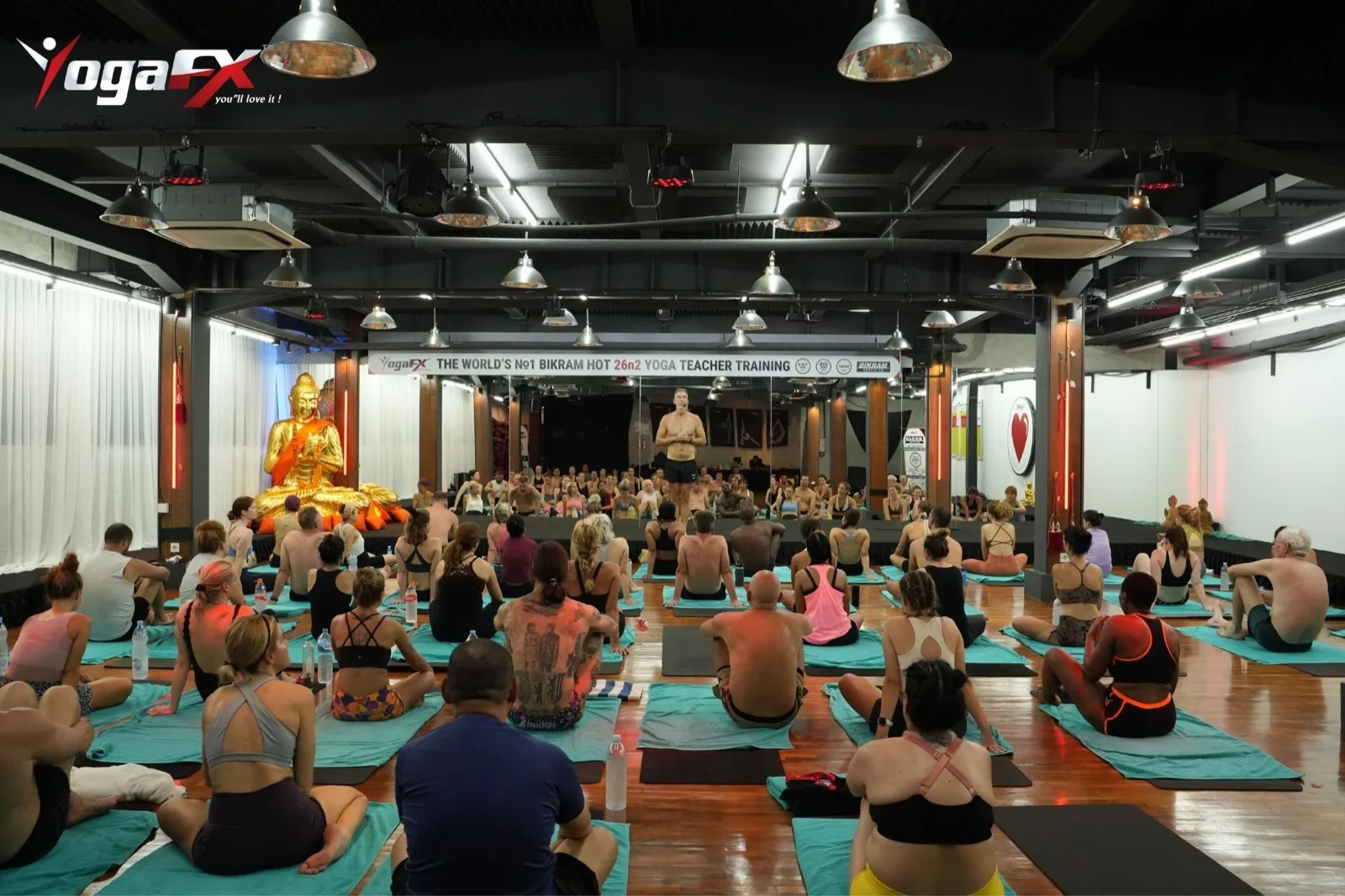
YogaFX teacher training is a hybrid. You study online at your own pace first, then finish with a six-day intensive in Bali. For a man who worries about being watched, that order helps. By the time you stand in a room with other trainees, you already know what comes next.
In calls with male applicants, Mr. Ian hears the same worry again and again. It is rarely the difficulty. It is the audience. Here is what home study gives you instead:
- Rewind. You can replay a lesson until the postures make sense, with no one waiting for you.
- Privacy. There is no mirror and no row of strangers while you are still stiff.
- Pace. You choose the evening, so study fits around work and family.
- Structure. The 26 postures and 2 breathing exercises come in the same order every time, so you always know where you are.
That is why the useful question about how men view yoga is not whether men should do it. It is where a man can start without feeling watched. For many men, the answer may be a living room.
What Students Say After Finishing the Training
These two trainees come from our YouTube reviews. They were not talking about stigma, and they are not all men. They do show how the experience felt once the first day was behind them.
This has been wonderful and I am very grateful for this experience and for meeting every single individual here.
Dior, YouTube review, 2024
Katalin had run a half marathon and tried hot yoga before, but never Bikram yoga. In her YouTube review (2025) she called the training a big challenge. Her mind felt strong, she said, while her body still had work to do.
A Four-Week Plan for a Hesitant Man
You do not need to decide anything big today. Try this instead, and stop at any point where something hurts:
- Week 1: Watch and breathe. Spend ten minutes a day learning the two breathing exercises while seated, with nothing else to do.
- Week 2: Learn the first standing postures slowly. Keep a wall or a sturdy chair nearby and move at half speed.
- Week 3: Add the floor work. Note which postures feel stiff, because that list is your real starting point.
- Week 4: Do one full session at your own pace. Write down what changed, then decide whether you want a first in-person class.
If you are in Bali, the Seminyak studio offers a free 1-day guest pass for your first class. If you are not, the plan above works just as well from home.
Your Next Step With YogaFX
Start with the free course preview. It lets you see how the practice and the online lessons work before you spend anything or meet anyone. Mr. Ian's wider look at the same subject sits on our main teacher-training site, including why more men are signing up to teach yoga.
When you are ready, the online course costs USD 329, or 4 x USD 82. The next Bali intensive checks in on Sunday 24 January 2027 and checks out on Friday 29 January 2027.
FAQ
Why don't men do yoga?
Surveys show fewer men practise: 10.3% of US men against 23.3% of women in 2022. Men often cite the female-leaning image, fear of being the stiffest person and doubt that yoga is hard enough. Research on masculine norms suggests that being a visible beginner is the real sticking point.
Is yoga for men?
Yes. In the same survey, 79.6% of men who practised did so to restore overall health, almost the same as women at 80.2%. Another 31.8% used it to manage pain. Yoga is not a gender-specific activity. Check with a healthcare professional first if you have an injury or a medical condition.
What do men worry about before a first class?
Frequent worries include looking stiff, standing out as a man in the room and not being challenged enough. They are worries about being watched, not about the postures. Starting at home lets you meet the practice privately and decide for yourself when anyone else sees you.
Can I study yoga teacher training online if I feel self-conscious?
Yes. YogaFX teacher training is a hybrid: you study online at your own pace first, then finish with a six-day intensive in Bali. By the time you meet other trainees you already know the sequence, which takes much of the pressure out of the first day.
Does yoga stigma affect men's mental health?
Research suggests that conformity to traditional masculine norms can affect how men with depression seek help and manage symptoms (Seidler et al., 2016). That review is not about yoga. If you are struggling, speak to a doctor or a mental health professional rather than relying on any single practice.
Still have questions? Message Mr. Ian and the YogaFX team through the contact page and we will answer them personally.