Eagle Pose: Steps, Common Errors and Cues for Online Students
By Mr. Ian Terry, E-RYT 500, founder of YogaFX · Published
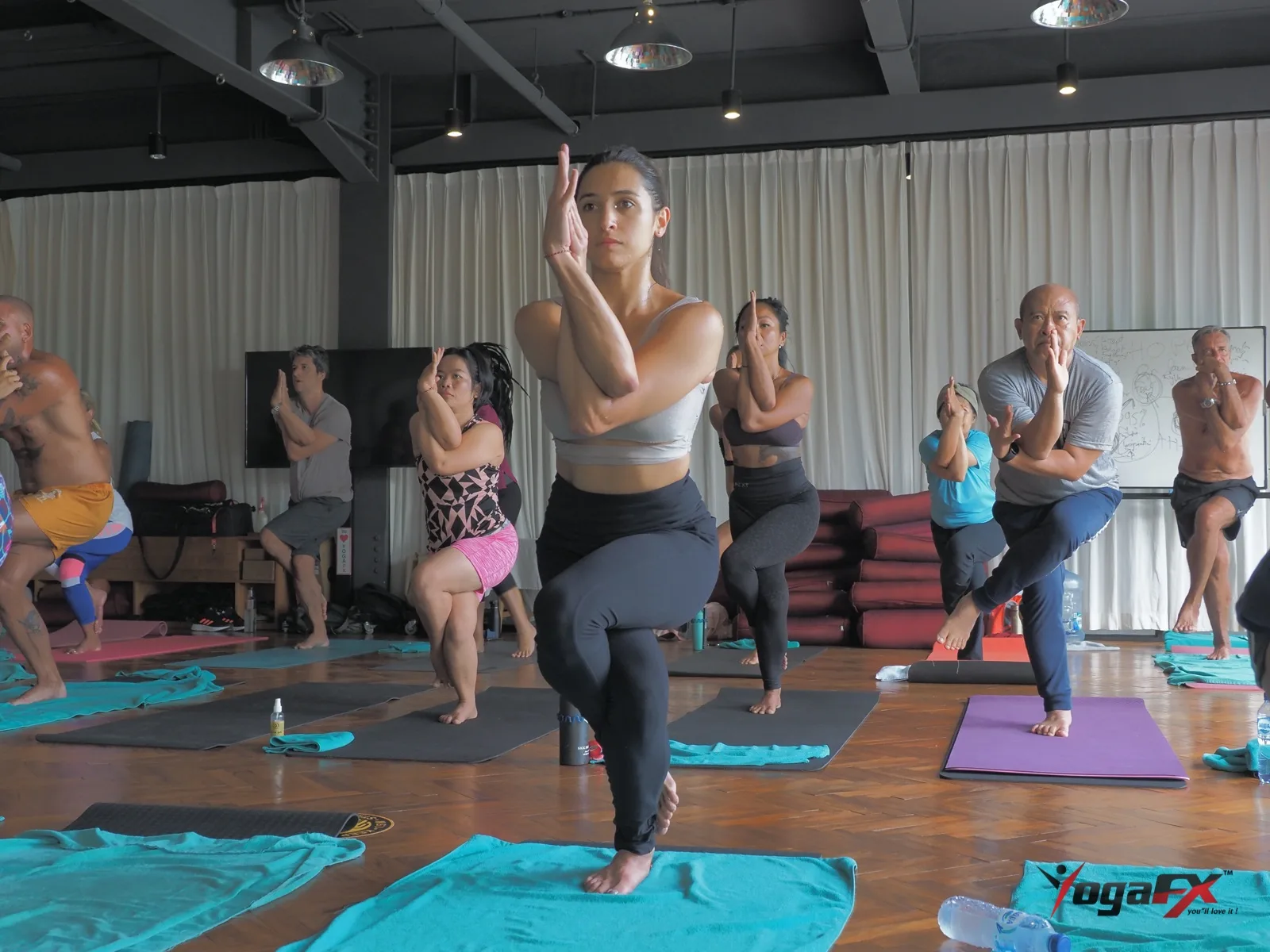
Eagle pose (Garudasana) is a standing balance where you sit low on one bent leg, wrap the other leg over it, wrap the arms in front of the face and hold your eyes on one spot. Online students can learn the order of the cues and a safe home version on a cool floor, before they ever stand in a 40°C room.
This guide is for adults who study the Hot 26&2 class from a living room, often around a full-time job. You may be learning the spoken cues for the first time, or you may want to teach one day. Either way, the shape comes first, and the words follow.
Mr. Ian Terry, our Founder and Lead Instructor (E-RYT 500, 12,000+ teaching hours), asks trainees to understand what a cue is for before they memorise it. We follow that order here. We don't print the dialogue script, because it's taught live at YogaFX. We describe the job each cue does, so the words make sense when you hear them.
If you want the full write-up of benefits and steps, our sister site has a complete eagle pose guide from the 26 and 2 method. This page asks a different question: how does someone studying online learn to do, check and eventually teach this pose?
This article is part of our Hot Yoga for Men guides.
Eagle Pose in Plain Words: What Garudasana Asks of You
Garuda is the Sanskrit word for eagle, and asana means pose. The picture is a bird on a branch with its wings folded tight, so the legs hold like a perch and the arms stay close to the body. In the Hot 26&2 class, eagle pose sits in the standing series, after awkward pose and before standing head to knee pose.
A Hot 26&2 class is one fixed 90-minute sequence of 26 postures and 2 breathing exercises, in a room at about 40°C with 40% humidity. If you are new to that format, our guide to what the 26 postures of a Bikram class are shows the whole order.
Eagle pose looks small, but it hands your body several jobs at once. The standing leg stays bent. The hips stay level. The shoulders stay down while the elbows lift. The breath stays slow, and the eyes stay still. Most students feel the effort long before they feel graceful, and that's normal.
- One leg works. The standing ankle, knee and hip keep correcting small wobbles.
- Two wraps. One leg wraps over the other, and the arms wrap in front of the chest.
- One fixed gaze. A still point for the eyes gives the brain one steady reference.
Eagle Pose Steps: A 4-Stage Rehearsal You Can Do at Home
Online study takes away the heat and the teacher. So we break eagle pose into four stages that you can rehearse beside a wall, and we give each stage a self-check. Treat it like learning a short piece of music, one phrase at a time.
Stage 1: Build the seat
Stand with the feet together and sit back and down, as if a low chair sat behind you. Keep the spine long and the weight even through both feet. The cues here are about the seat, because everything after it depends on a stable base.
Stage 2: Shift onto one leg
Press the standing foot into the floor and let the weight travel over it. The standing knee stays bent the whole time. At home, rest a hand on a wall or a chair back until the weight shift feels calm.
Stage 3: Wrap the leg and the arms
Lift the other leg and cross it over the standing thigh. Hook the foot behind the calf only if it reaches without a twist at the knee. Then cross the arms, bring the forearms together and lift the elbows to chest height while the shoulders drop.
Stage 4: Sit lower and unwrap slowly
Settle the hips a little lower, keep the back long and fix the eyes on one point. Then release the arms, uncross the leg and stand tall for a few breaths before you switch sides. Leaving the pose well is part of the skill.
| Stage | What the cue is for | Home aid | Self-check on camera |
|---|---|---|---|
| 1. Build the seat | Creates a low, stable base | Wall at your back, feet together | The spine stays long and the heels stay heavy |
| 2. Shift onto one leg | Puts the weight over a bent standing knee | Hand on a chair back or counter | The standing knee points over the second toe |
| 3. Wrap legs and arms | Shortens the lever and opens the upper back | Toes on the floor if the hook does not reach | The elbows lift while the shoulders stay low |
| 4. Sit lower, unwrap | Adds effort, then teaches a calm exit | Stand tall beside the wall | No wobble on the way out |
Common Eagle Pose Errors You Can Spot on Camera
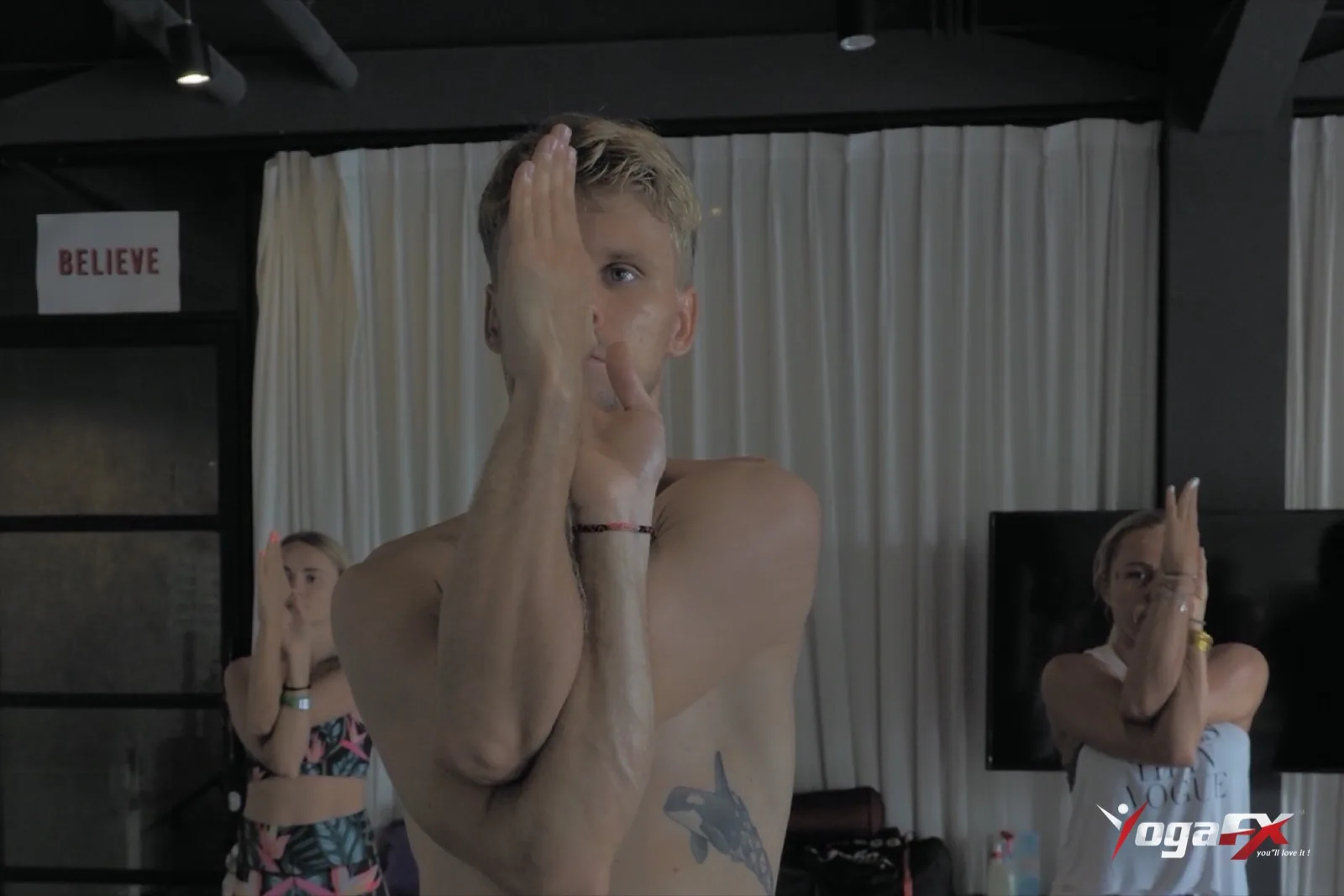
At home you're your own teacher, so a phone becomes a mirror. Film one side from the front and the other from the side. Then watch with the sound off. Most mistakes in eagle pose come from chasing the wrap instead of protecting the base.
- Standing up too tall. The seat disappears and the balance gets harder, so sit back down before you wrap.
- Locking the standing knee. A straight leg wobbles more. Keep it soft and pointed over the second toe.
- Forcing the foot behind the calf. That can twist the knee. Rest the toes on the floor instead, because a smaller wrap is still eagle pose.
- Hiking the shoulders. The elbows should rise while the shoulder blades slide down the back.
- Holding the breath. Breathe slowly through the nose and keep the jaw soft.
- Letting the eyes wander. Pick one spot at eye level and keep it.
For example, a student who always tips out of eagle pose to the same side is usually leaning away from the standing leg. A lower seat and a fixed gaze usually fix both at once. If you feel sharp pain, pinching or tingling, come out, rest and tell your teacher.
Eagle pose also pairs well with its neighbours in the series. Our guide to awkward pose cues for online students trains the same low seat, and the standing head to knee pose steps build on the single-leg balance you practise here.
Eagle Pose Cues: How Teaching Trainees Learn to Say Them
If you plan to teach, the voice matters as much as the shape. Trainees learn the spoken part of the class in stages, and our guide to the Bikram yoga dialogue explains how that works. Eagle pose is a good posture to practise on, because the cues follow the body from the floor upward.
Mr. Ian Terry asks trainees to say each stage aloud while standing still. You hear your own pace and notice which stage you skip. These habits help most:
- One body part per phrase. Short cues are easier to follow in a warm room.
- Order from the ground up. Feet, knees, hips, arms, then eyes.
- Say what to do, not what to avoid. "Sit lower" lands better than "do not stand up".
- Leave a pause. Students need a breath to act on each cue.
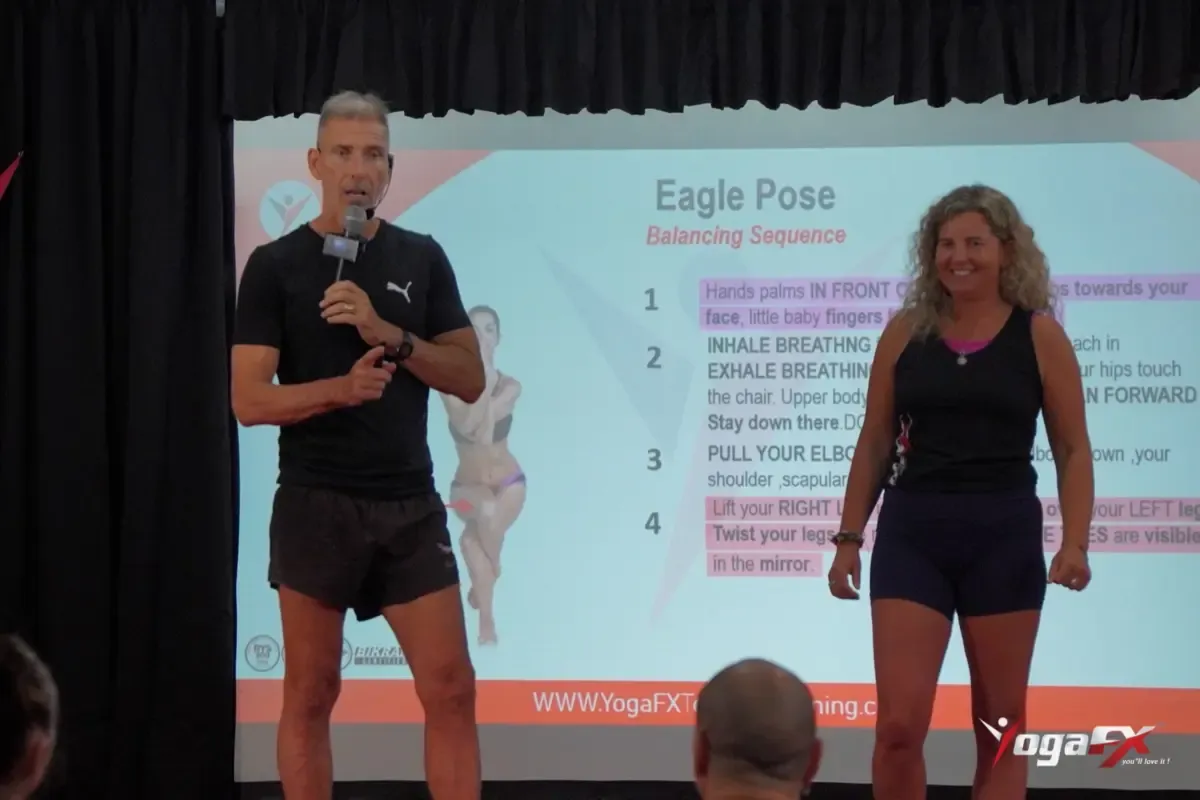
The online course also includes a premium lecture on eagle pose, so you can watch the cues explained before you rehearse them. The picture below shows Mr. Ian Terry presenting that lecture slide with a trainee.
What the Science Says About Balance and Single-Leg Work
Eagle pose is a single-leg balance posture, so general research on balance training is a fair guide, with limits. Nobody has tested eagle pose as a treatment for any condition, and we do not claim it treats one. We can say what trusted health sources report about balance exercises, because it shapes how carefully we teach this pose.
Why balance work matters
Mayo Clinic says older adults especially need balance exercises to help prevent falls, and that the risk of falling goes up after age 65. In its guide to balance exercises, it advises holding a single-leg stand as long as you keep good form, up to 30 seconds, and using a table or counter for support if you need it.
The Hospital for Special Surgery reports in its article on the best balance exercises as you age that older adults who can balance on one foot for at least 30 seconds are much less likely to fall. It also says most people can keep, and even gain, balance with regular, targeted exercise. If you feel unsteady, it advises holding a countertop or a sturdy chair back first.
Effort and safety in a hot class
On effort, a 2014 University of Wisconsin-La Crosse study (Porcari et al.) measured a full 90-minute hot class. It found about 333 kcal burned by women and 460 kcal by men, with the heart near 80% of its maximum. That figure covers the whole class, not eagle pose alone. It shows why the standing series feels like real exercise.
Mayo Clinic also says that if you have serious balance problems, or a condition that affects your bones, joints or muscles, you should get your healthcare professional's OK before doing balance exercises. This is general information, not medical advice. Tell your teacher about any knee, hip, ankle or back problem, and stop if you feel dizzy.
Student Voices: Learning a Hard Pose Without a Studio Nearby
Eagle pose humbles almost everyone, and trainees don't hide it. Here are three of them, in their own words, from our YouTube reviews.
“This six days yoga journey was very challenging and deeply rewarding.”
Olga, YouTube review, 2025
“Watching everyone's growth here, it touched me, my heart is full.”
Jennifer, YouTube review, 2025
“We are becoming one family.”
Elvia, YouTube review, 2023
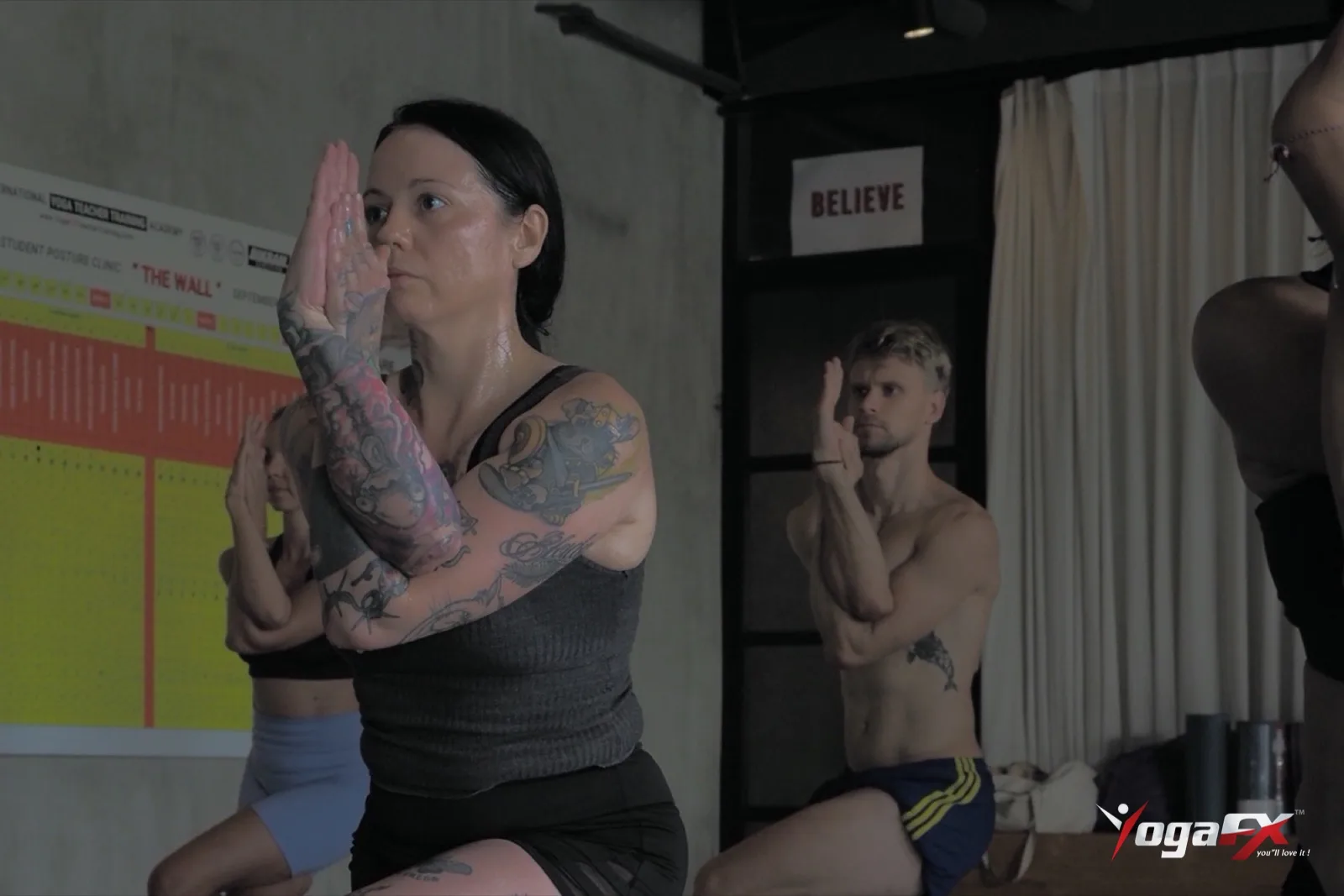
Olga's video above comes from our YouTube channel. She calls the week hard and rewarding, and she is honest that she did not yet feel ready to teach. That honesty is useful for eagle pose too: you do not have to hold the deepest wrap on day one, and you do not have to be a teacher yet to start learning.
From Home Rehearsal to the Bali Intensive
A home plan builds the habit, but a teacher in the room closes the gap. In the hybrid route you finish the online pre-course. Then you join a six-day teaching intensive at YogaFX in Seminyak, Bali. Graduates earn Yoga Alliance RYT 200 and the Bikram Hot 26&2 200-Hour International Yoga Certification. The next batch checks in on Sunday 24 January 2027 and checks out on Friday 29 January 2027.
The online course page lists what you study at home. The online course is USD 329, or 4 x USD 82, and the Starter Kit is USD 98, or 2 x USD 49.
You don't need to decide today. Run stages one and two this week, film one round from the side, and see which stage you skip. Then you will know what to ask Mr. Ian before you book.
FAQ
How do trainees learn to say eagle pose cues?
Trainees learn the cues in stages. First they understand what each cue is for, then they say it aloud while standing still, and only then do they add movement and pace. Short phrases, one body part at a time, and a pause for the student to act work best.
Can you learn eagle pose online?
Yes, you can learn the order, the shape and the purpose of each cue online. Rehearse on a cool floor beside a wall, say each stage aloud and film yourself from the front and the side. A teacher in the room is still needed to correct your alignment in the heat.
What if my foot will not hook behind the calf?
Rest the toes of the top foot on the floor and treat that as a complete eagle pose. Forcing the foot behind the calf can twist the knee, and depth is not the goal here. Control of the standing knee and the hips matters more than reaching the full wrap.
Who should check with a doctor before eagle pose?
Ask a healthcare professional first if you have a knee, hip, ankle or back problem, balance problems or blood pressure concerns, or if you feel dizzy in heat. Mayo Clinic gives similar advice for balance exercises. Keep a wall or chair within reach, and stop at any sharp pain.
How long should you hold eagle pose at home?
Start with a few seconds per side and build slowly. Mayo Clinic suggests holding a single-leg stand as long as you keep good form, up to 30 seconds, with a table or counter nearby for support. Rest between sides, and stop if your standing knee pinches or twists.
Still have questions? Message Mr. Ian and the YogaFX team on WhatsApp and we will answer them personally.