Does Hot Yoga Improve VO2 Max? Trial Evidence for Busy Adults
By Mr. Ian Terry, E-RYT 500, founder of YogaFX · Published
Does hot yoga improve VO2 max? It might, but the hot yoga VO2 max evidence is small and early. In one four-week trial of 22 adults, VO2 max rose in the group that took 12 heated classes, yet the two groups did not differ significantly. A single class barely moves it. Here is what that means for a busy week.
This guide is written for adults who fit practice around a job. You want to know whether 90 minutes in a hot room buys real fitness, or whether the time is better spent elsewhere. We read the two trials most often quoted, and we turn them into a plain time budget.
Mr. Ian Terry, E-RYT 500, Founder and Lead Instructor at YogaFX, has taught more than 12,000 hours, and he asks trainees to read research this way before they repeat it to students.
It is general education, not medical advice. Please speak to a doctor before you start heated classes, especially if you have a heart or blood pressure condition or take regular medication.
This article is part of our Hot Yoga for Men guides.
Does Hot Yoga Improve VO2 Max? The Short Answer for Busy Adults
VO2 max is the most oxygen your body can use during hard exercise. Researchers usually measure it on a treadmill, with a mask, while the effort ramps up until you cannot continue. A higher number generally goes with a bigger aerobic engine, which is why fitness watches like to show it. That is also why hot yoga VO2 max claims spread so quickly online.
So the honest answer on hot yoga VO2 max has two parts. Over several weeks of heated classes, one small trial saw VO2 max rise in the hot group. In a single class, a separate study found that the oxygen cost was about the same as the same class in a cooler room. That's the whole picture so far, and it's thinner than many articles suggest.
- For a four-week block: the hot yoga VO2 max result is promising, but it comes from one trial of 22 adults, and the groups did not differ from each other.
- For one class: oxygen use was close to the cooler-room figure, so heat alone did not raise the workload.
- For your week: treat hot yoga VO2 max gains as a possible bonus, not a guaranteed fitness test result.
If you want the same question answered through the lens of a teacher-training programme, our team at the main training site wrote a companion guide for yoga teachers. This page stays with the reader who has a calendar to protect and wants the hot yoga VO2 max facts without the hype.
What the Four-Week Trial Found About Hot Yoga VO2 Max
Most claims about hot yoga VO2 max trace back to one randomised trial. Bourbeau and colleagues (2021) published it in the International Journal of Yoga, under the title Cardiovascular, Cellular, and Neural Adaptations to Hot Yoga versus Normal-Temperature Yoga.
Who took part and what they did
Twenty-two adults joined, 11 men and 11 women, with an average age of 26. They were split at random into two groups. One practised in a heated chamber and the other in a room at 18 to 22°C. Each person did three 75-minute sessions a week for four weeks, which makes 12 sessions in total.
What changed, and what did not
In the hot group, VO2 max rose from 3.22 to 3.46 litres per minute, a change the authors report as significant. In the normal-temperature group it moved from 3.00 to 3.05, which was not significant. By our own arithmetic, the hot group gained about 0.24 litres per minute.
There's a catch, though. The paper states that no differences were detected between the groups. So the trial cannot say that heat did better than a cooler room. It says only that the hot group improved on its own starting point, and the other group did not clearly do so. That is the core of the hot yoga VO2 max story.
- The sample was small, so a few people could shift the result.
- The volunteers were young, so older or less fit adults may respond differently.
- The sessions ran 75 minutes, not the 90 minutes of a full class.
- The authors themselves note that their VO2 max finding contrasts with other studies.
Put simply, the hot yoga VO2 max result is a reason to look closer, not a promise. If someone tells you hot yoga raised their fitness score by a fixed percentage, ask which study they mean and how many people were in it.
The same trial also reported cellular heat adaptations in the hot group. We explain that side of the story in our guide to heat shock proteins.
What One Class Does to Hot Yoga VO2 Max and Oxygen Use
A second study looked at a single session. Lambert and colleagues (2020) published it in the International Journal of Exercise Science. Sixteen experienced practitioners, 14 women and 2 men with an average age of 40, did a one-hour Bikram sequence twice, in random order. One session was at 105°F (about 40°C) and one at 74°F, both at 40% humidity.
The group's baseline VO2 max averaged 36.9 millilitres per kilogram per minute. During class, the figures looked like this:
- Oxygen use: 8.9 millilitres per kilogram per minute in the heat and 8.6 in the cooler room.
- Share of maximum: 25.3% in the heat and 23.5% in the cooler room.
- Heart rate: 113 beats per minute against 109.
- Energy use: 156 kilocalories against 151 for the hour.
The authors reported that none of those measures differed significantly between the two rooms. Their conclusion was that heated yoga "does not significantly elevate aerobic energy cost" compared with the same class in a cooler room. It did raise fat use and hip range of motion in that single session, but those are short-term effects, not proof of lasting change.
So in this study a class sat at roughly a quarter of an experienced practitioner's maximum, which explains why one class did little for hot yoga VO2 max. That is a steady, low-to-moderate load, which is why it feels hard in the heat but does not behave like interval training. For a pacing guide by age, see our article on hot yoga heart rate zones.
A Hot Yoga VO2 Max Time Budget: Minutes Against Evidence
Busy adults rarely ask about physiology. They ask whether the minutes are worth it for hot yoga VO2 max or any other gain. The CDC adult activity guidelines say adults need at least 150 minutes of moderate-intensity activity a week, or 75 minutes of vigorous activity, plus two days of muscle-strengthening. The table below lines up four realistic weeks against that target and against the evidence we just covered.
| Weekly plan | Minutes per week | Minutes over 4 weeks | What the evidence says |
|---|---|---|---|
| One 90-minute class | 90 | 360 | Below the 150-minute target on its own. One class showed no extra oxygen cost from heat (Lambert 2020). |
| Two 90-minute classes | 180 | 720 | Above 150 minutes if the effort feels moderate to you. No trial tested this exact dose. |
| Three 75-minute sessions | 225 | 900 | The dose in the 12-session trial, where the hot yoga VO2 max rose in the hot group (Bourbeau 2021). |
| Three 90-minute classes | 270 | 1,080 | The heaviest realistic week for most jobs. No trial tested it, so it is a plan, not a result. |
How to read the table
Notice what the table does not say. It does not say that 270 minutes is better than 180. Nobody has run that comparison for hot yoga VO2 max. It just shows how the minutes stack up, so you can decide with your calendar open.
Also remember that the CDC target counts effort, not room temperature. If a class leaves you able to speak only in short sentences, it probably counts as vigorous for you. If it feels easy, it may not. Your own breathing is the guide.
Fitting Hot Yoga VO2 Max Goals Around a Full-Time Job
You don't need a perfect plan. You need one you can repeat for a month. These three patterns suit most working weeks, and each one keeps a rest day in place.
- The light week: one class midweek and one longer home session at the weekend. Good for your first month in the heat.
- The steady week: two evening classes with a rest day between them, plus a short walk on the other days.
- The full week: three classes, only after you have handled the heat comfortably for several weeks and your doctor agrees.
Start lighter than you think you need to. You can't rush adaptation to heat. Heat adds a second demand on top of effort, because your body is also working to cool itself, and that can blur any hot yoga VO2 max benefit you hope for. If you are brand new, our guide to preparing at home before your first hot class covers what to bring and how to pace the first weeks.
Log two numbers, not twenty
A fitness watch can show a dozen figures, and most add worry rather than insight. Write down just two after each class. First, how hard it felt on a scale of one to ten. Second, how long your breathing took to settle in the first rest. Over a month, a falling second number is a better sign of progress than any single watch estimate.
Treat watch scores for hot yoga VO2 max as rough estimates. The trials above measured it in a lab on a treadmill, to the point of exhaustion, which is a very different test from wearing a wrist sensor through a class.
What These Hot Yoga VO2 Max Trials Cannot Tell You
Reading research well means knowing where it stops. A few gaps matter to a busy adult who wants a clear plan.
- Neither study compared yoga with running, cycling or any other training. We cannot say hot yoga is better, or worse, than those.
- Neither studied older adults, people with a health condition or complete beginners to exercise.
- Neither tested a full 90-minute class repeated for months, which is how many people actually practise.
- The one-class study measured experienced practitioners, who handle the sequence more efficiently than a new student, so its hot yoga VO2 max figures may not fit a beginner.
That last point matters for pacing. A new student can find the same class far harder than the 16 experienced volunteers did. It is also why we pair this topic with our look at whether hot yoga is a good workout, which covers the calorie and heart-rate side.
If raising your hot yoga VO2 max is a firm goal, discuss it with a doctor or coach. These trials do not show that yoga replaces other aerobic training, and strength work also matters, because the CDC asks for two muscle-strengthening days each week.

Heat, Safety and Knowing When to Rest
Fitness is only useful if you can keep training. In a hot room, the first rule is to stop when your body says so, whatever a plan or a watch suggests. Dizziness, nausea, cramps and unusual shortness of breath all mean rest. Chest pain, fainting or confusion needs urgent medical help.
Our guide to hot yoga temperature explains what a 40°C room does to a student. Read it before you build a weekly routine around heat.
How YogaFX Trainees Learn to Talk About Fitness Honestly
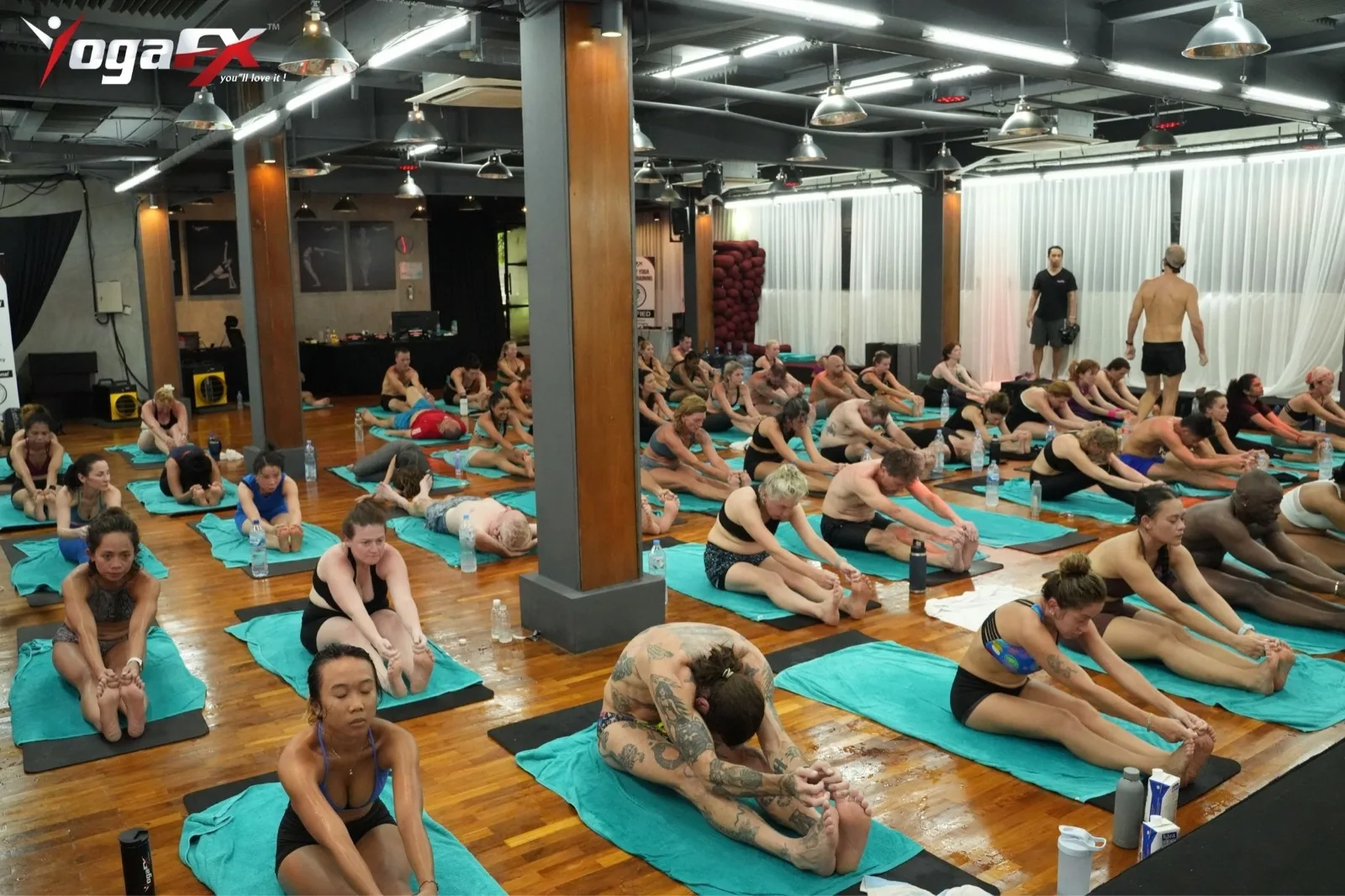
A YogaFX studio class runs 90 minutes at 40°C (104°F) with about 40% humidity, and the heat comes from the tropical climate rather than electric heaters. Mr. Ian Terry spent five years, from 2014 to 2019, training with the founder of the Bikram Hot 26&2 method. He founded YogaFX in 2017, and more than 1,500 graduates from over 80 countries have trained since.
Trainees are taught to say what the research supports on hot yoga VO2 max and to attach the sample size every time. "One small trial saw a rise after four weeks of heated classes" is a sentence you can defend. "Hot yoga raises your VO2 max" is not. That habit protects your students, and it protects you. It is the same habit we use when a student quotes a hot yoga VO2 max figure from a watch.
You can learn the theory from home first. The online course costs USD 329, or 4 x USD 82, and our guide to hybrid yoga teacher training shows how it fits around a day job. Many students are surprised how much they can absorb in short evening sessions.
Want to feel the room before you decide? The Free 1-Day Guest Pass at our Seminyak studio gives you a first class at no cost. Message Mr. Ian on WhatsApp to book it.
What Trainees Say About Learning With Us
Numbers help, but confidence comes from good teaching, not from a hot yoga VO2 max score. These reviews come from graduates, and we use first names only.
“Amazing hot bikram yoga experience! Extraordinary guru Mr Ian and YogaFX team.”
Jamasb, Google review, 2026
“I truly enjoyed my time attending the course and the practice sessions. I learnt a lot and really improved my knowledge and skills in yoga teaching.”
Musyatun, Google review, 2023
Manou describes struggling to lift a leg to 45 degrees in Locust pose, then lifting it past 90 degrees with help from the team, and being moved to tears.
Manou, YouTube review, 2025 (paraphrased)
FAQ: Hot Yoga VO2 Max Questions
Does hot yoga increase VO2 max?
It may, but the hot yoga VO2 max evidence is thin. In one trial of 22 adults, VO2 max rose in the group that took 12 heated classes over four weeks. However, the authors found no significant difference between the hot and cooler groups, so heat itself was not shown to be the cause. Larger trials are needed.
Does yoga improve VO2 max?
The same trial gives a cautious answer. In the cooler yoga group, VO2 max moved from 3.00 to 3.05 litres per minute, which was not a significant change. That suggests a few weeks of ordinary yoga may not shift it much in healthy young adults, though one small study cannot settle the question.
Does hot yoga burn more calories than regular yoga?
In a 2020 study of 16 experienced practitioners, one hour of the same Bikram sequence used about 156 kilocalories in a 40°C room and 151 in a 23°C room. The authors found no significant difference. So heat alone did not clearly raise energy use in that group.
Is hot yoga enough cardio for a busy adult?
Possibly part of it. The CDC asks adults for at least 150 minutes of moderate activity a week, plus two muscle-strengthening days. Two 90-minute classes add up to 180 minutes, but whether they count depends on how hard they feel to you. Check with your doctor, and add other activity if needed.
What does VO2 max measure in these studies?
It is the most oxygen the body can use during hard exercise. In the four-week trial it was measured with a maximal treadmill test before and after the programme. In the single-class study, the group's baseline average was 36.9 millilitres per kilogram per minute. Watch estimates are rougher than lab tests.
Still have questions? Message Mr. Ian and the YogaFX team on WhatsApp and we will answer them personally.
This guide is general education, not medical advice. Please consult a healthcare professional before you begin or change a hot yoga routine, especially if you are pregnant, take medication or have a heart or blood pressure condition.