Triangle Pose Dialogue: Learning Trikanasana Online Before Bali
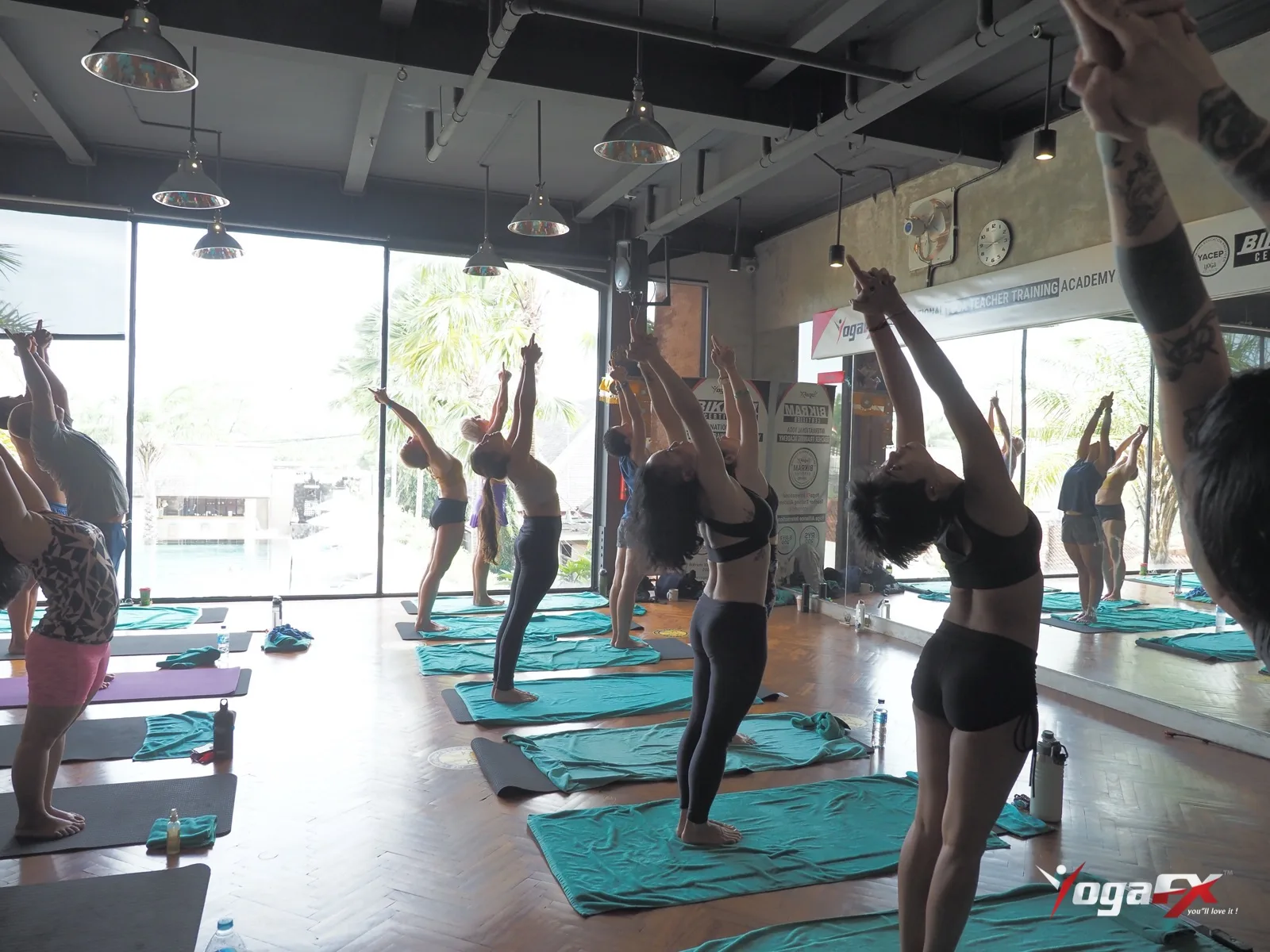
By Mr. Ian Terry, E-RYT 500, founder of YogaFX · Published
Triangle pose (Trikanasana in the class sequence) is one of the harder standing postures in the Hot 26&2 class, and you can start learning it online before you reach Bali. Study the spoken cues in order, rehearse the shape on a cool floor at home, and save the full heat for the studio.
This guide is for busy adults who plan to join the Bali intensive and want a head start. You probably work full time, and you might never have heard the dialogue in a hot room. Here's the good news: the words, the order and the shape are all things you can study in short evening sessions.
Mr. Ian Terry, our Founder and Lead Instructor (E-RYT 500, 12,000+ teaching hours), asks trainees to learn each posture slowly before they add heat. We follow that order here. First you learn what the words ask for, then you rehearse them cold, and then you meet the heat with YogaFX in Bali.
This article is part of our Hot Yoga for Men guides.
Triangle Pose Dialogue: What the Spoken Cues Do for You
In a Hot 26&2 class, a teacher talks you through every posture with the same words each time. We call that script the dialogue. It tells you where to place the feet, when to bend the knee, where to look and when to come out. If you are new to the idea, our guide to the Bikram yoga dialogue explains how to start.
The script matters most in triangle pose, because the shape has many moving parts. Your feet, knees, hips, spine, arms and eyes all need a job. Without a voice to sequence them, most students fix one part and lose another.
That is why we teach the order of cues before we teach depth. When you know what comes next, you stop guessing. Your attention moves from "what am I supposed to do?" to "how does this feel?" That second question is where real learning happens.
We do not print the exact words here, because the script is taught live. What we can do is describe what each stage of the cues is for, so the words make sense when you first hear them.
Why Triangle Pose Feels Harder Than It Sounds
From the back of the room, triangle pose looks like a calm side stretch. Inside it, you hold a deep bend in the front knee, keep the back leg straight and strong, and turn your chest toward the ceiling. All of that happens in a room at about 40°C with around 40% humidity.
The pose also arrives late in the standing series. By then your legs have already worked through several postures, so the front thigh starts to burn early. That surprises many first-time students.
Our sister site breaks the pose down in its cue-by-cue triangle pose guide, including the common alignment errors. Here we focus on a different question: how do you prepare for it when you cannot attend a hot class every week?
- Heat. You cannot copy a 40°C room at home, so you train the shape and the words instead.
- Time. A full class takes 90 minutes, but a focused rehearsal takes ten.
- Feedback. At home, no teacher watches your knee. A phone camera and a mirror fill part of that gap.
How to Study the Triangle Pose Dialogue at Home: 5 Steps
Treat the cues like a short piece of music. You don't memorise it in one sitting. You return to it a little at a time, and the order becomes familiar. Here are five steps that fit around a working day.
1. Listen first, without moving
Play the course audio or video once and only listen. Notice the rhythm of the cues and where the teacher pauses. Moving too early splits your attention, and you remember neither the words nor the shape.
2. Mark the stages on paper
Write the stages in your own words: stance, foot, arms, knee, hips, reach, gaze, breath, exit. You are not copying the script. You are building a map you can check yourself against.
3. Rehearse the shape slowly on a cool floor
Warm up first. Then walk through the stages at half speed, with a shallow knee bend and a narrow stance. Stop before any pinch. Our guide to original hot yoga at home explains how to treat home sessions as a rehearsal, not a replacement.
4. Film one round and watch it with the sound off
Prop your phone at hip height, side on. Watch for three things only: does the front knee track over the ankle, does the back leg stay straight, and does the chest turn open? Pick one fix for the next session.
5. Say the stages back, standing relaxed
After you move, stand still and recite your own map from memory. If you lose your place, you know which stage to review. If your balance wobbles, you know which part of the body to review. Either slip tells you something useful.
| Stage of the cues | What the words are for | How to rehearse it at home | Self-check |
|---|---|---|---|
| Stance and feet | Give the front knee room to bend without losing the back leg | Step wide on a towel and turn the front foot out | Both feet feel heavy, and the front heel lines up with the back arch |
| Arms and spine | Keep the spine long before anything bends | Lift the arms to shoulder height and stand tall for two breaths | Shoulders stay down and the ribs do not flare |
| Knee and hips | Build the strength in the front leg and send the hips back | Bend the front knee a little, then a little more, over a mirror or phone | The knee tracks over the ankle, not inward |
| Reach and gaze | Lengthen the side body and open the chest | Reach the top arm long, then turn the eyes upward only as far as the neck allows | No neck strain, and the chest turns toward the ceiling |
| Breath and exit | Keep the pose steady and leave it as one piece | Count slow breaths, then rise with the arms still long | Breath stays smooth, and you reset the feet before the second side |
Home Rehearsal Without Heat: Floor, Mirror and Phone
A cool room changes how the pose feels. Your muscles are not as loose, and you do not sweat. That makes home practice safer in one way and less forgiving in another, because you cannot rely on the heat to help you stretch.
So set up a simple space. You need a flat floor, a towel or mat that does not slide, and about two metres of width. A mirror helps, but a phone camera works too. Keep a wall within reach if balance feels shaky.
- Warm up for five minutes. Walk, do easy hip circles and lunge gently before any deep bend.
- Keep the bend shallow. A smaller knee bend still teaches the order of the cues.
- Use a short hold. Five slow breaths on each side is enough for a first week.
- Stop at pain. Tension in the thigh is normal. Sharp or pinching pain in a joint is not.
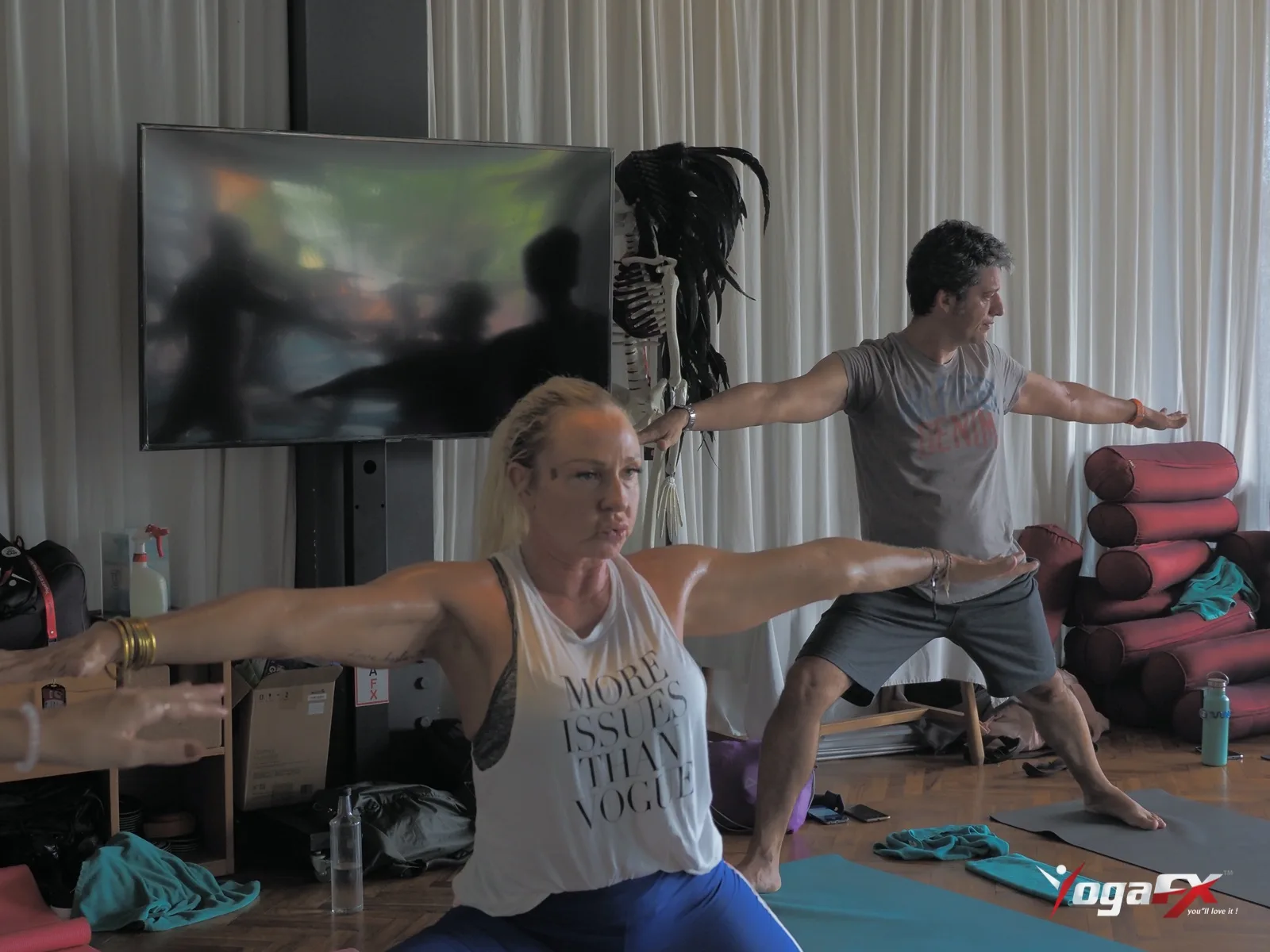
If your hips feel tight, add a few easy hip circles and a gentle lunge before each session. Small balance drills help too, because they prepare the ankles and hips for wide-leg work.
What the Science Says About Warm Muscles and Stretching
Triangle pose is a stretch as well as a strength hold, so the general stretching advice applies. The Mayo Clinic says you may hurt yourself if you stretch cold muscles. It also advises smooth movement without bouncing, and it says to expect tension while you stretch, not pain.
That advice shapes how we teach home rehearsal. It boils down to three rules:
- Warm up first. Walk, circle the hips and lunge gently before any deep bend.
- Move smoothly. Ease into the shape without bouncing.
- Stop at pain. Tension in the thigh is expected. A pinch in the knee or hip is your cue to leave the pose.
It also explains why a hot room feels easier than a cool one, even though the stretch is the same.
On flexibility itself, Harvard Health says regular stretching keeps muscles long, lean and flexible. It adds that it takes weeks to months to get flexible, and that you must keep working to maintain it. So a short, steady habit beats one long session.
What about effort? A 2014 University of Wisconsin study (Porcari et al.) measured a 90-minute hot class at about 333 kcal for women and 460 kcal for men, with the heart working near 80% of its maximum. That figure covers the whole class, not triangle pose alone, but it shows why the standing series feels like real exercise.
This is general information, not medical advice. If you have a knee, hip, back or neck problem, high or low blood pressure, or you feel dizzy in the heat, talk to a healthcare professional before you practise, and tell your teacher before class.
A 4-Week Plan for Busy Adults Before the Intensive
You don't need long sessions. You need a pattern you can keep on a heavy week. Here is one plan, built for people who study after work. It is our own teaching plan, not a clinical protocol.
| Week | Focus | Time per session | What to film or check |
|---|---|---|---|
| 1 | Listen to the cues and mark the stages on paper | 10 minutes, 3 evenings | Can you write the stages in order from memory? |
| 2 | Rehearse the stance and the knee bend, shallow and slow | 10 minutes, 3 evenings | Does the front knee track over the ankle? |
| 3 | Add the reach, the gaze and five slow breaths each side | 12 minutes, 4 evenings | Does the chest open without neck strain? |
| 4 | Run the whole set twice, then say the stages back standing | 15 minutes, 4 evenings | Which stage do you still skip, and why? |
Notice that no week asks you to go deeper. Depth comes later, in the heat, with a teacher watching. Your job at home is order, steadiness and honest self-checks, and that's plenty.
Student Voices: Why the Words Matter
Trainees tell us the same thing again and again. Knowing the details of the dialogue changes how a class feels. Here are three voices from YogaFX students.
“Just knowing the details of it, the dialogue and everything, has just been so empowering.”
Sandra, YouTube review, 2025
“Gorgeous and very challenging teacher training experience. The team is highly qualified, kind and disciplined.”
Annabel, Google review, 2026
“Mr. Ian and his team create a wonderful learning experience, not to be missed if you have the opportunity!”
Gary, Yoga Alliance review, 2025
Sandra's short video above comes from our YouTube channel. She describes the experience as humbling and empowering, and she says learning the dialogue deepened her practice.
Where Triangle Pose Sits in the Standing Series
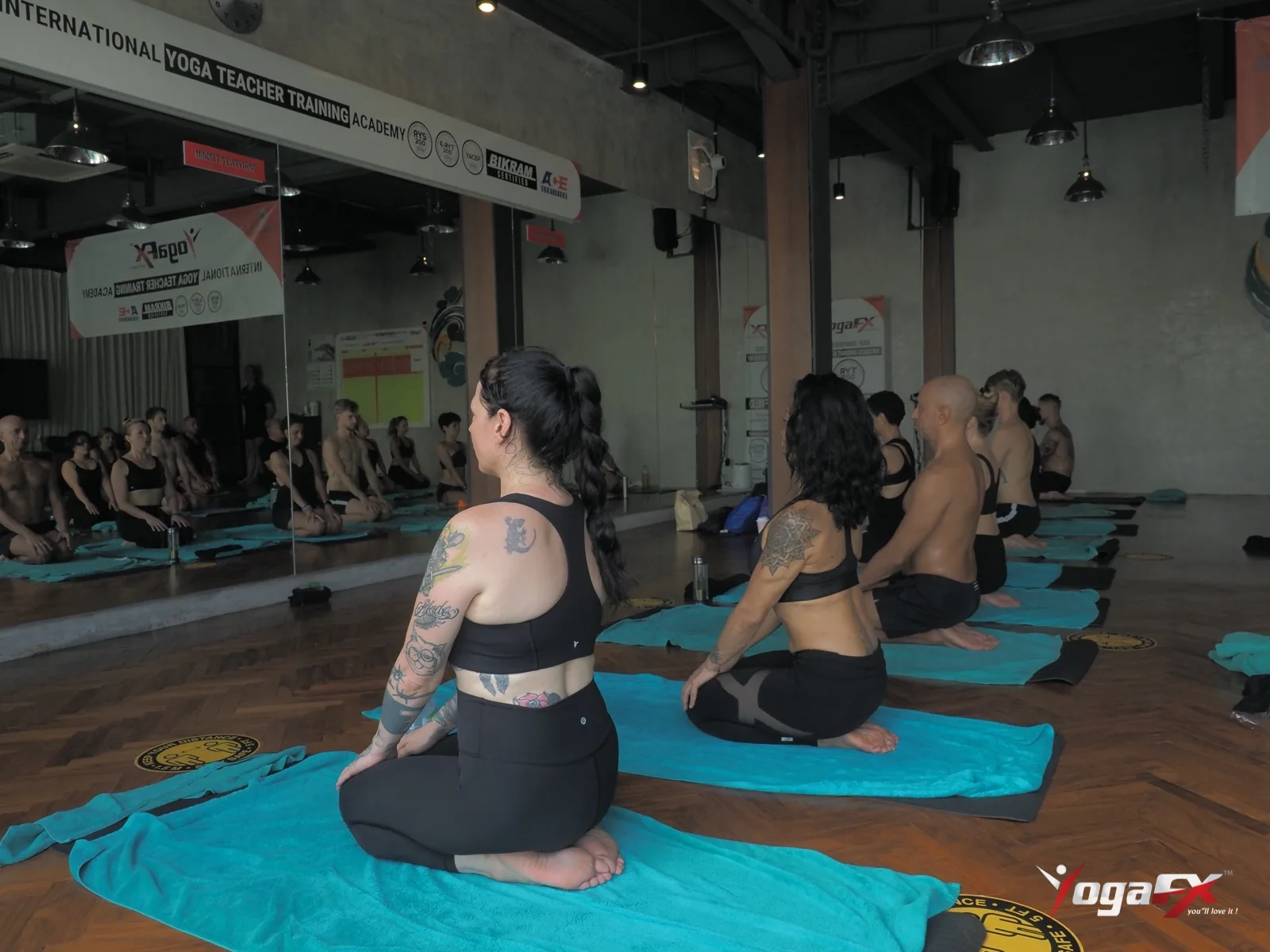
Triangle pose comes late in the standing series, after standing separate leg stretching and before standing separate leg head to knee. Each posture is done in two sets on each side, so the second set shows you what you changed in the first.
If you want to compare it with a one-leg posture, our standing head to knee pose guide gives a home study plan for the balance side of the series. Triangle pose asks for a different skill: a wide, stable base and a long spine.
Because the poses link up, your home rehearsal of one helps the others. A stronger front leg in triangle pose carries into every wide-leg posture. A calmer breath carries into the whole class.
From Home Study to the Bali Intensive
A home plan builds the habit, but a teacher's eyes close the gap. In the hybrid route, you finish the online pre-course, then join a six-day teaching intensive in Bali. Graduates earn Yoga Alliance RYT 200 and the Bikram Hot 26&2 200-Hour International Yoga Certification. The next batch checks in on Sunday 24 January 2027 and checks out on Friday 29 January 2027.
Our guide to hybrid yoga teacher training shows how the weeks fit around work, and the online course page lists what you study at home. The online course is USD 329, or 4 x USD 82, and the Starter Kit is USD 98, or 2 x USD 49.
You don't need to decide today. Run week one of the plan, film one round and see which stage you skip. Then you will know what to ask Mr. Ian before you book.
FAQ
What is triangle pose in Sanskrit?
Triangle pose is usually written Trikonasana in Sanskrit. The Hot 26&2 sequence lists it as Trikanasana, and both names point to the same idea: a shape made of three angles. Your legs, torso and arms build that triangle together, so none of them can hide while you hold it.
What muscles does triangle pose stretch?
Triangle pose stretches the back of the straight leg, the inner thighs, the hips and the side of the torso. It also works the front thigh, which holds a deep bend. These are general descriptions of the shape, not a medical claim, so tell your teacher about any joint pain before class.
Can you learn triangle pose online?
You can learn the order of the cues, the vocabulary and the shape online, and rehearse them at home on a cool floor. You cannot learn how your body handles 40°C heat, or how to correct a fading student. That part needs a teacher in the room, which is why the intensive finishes the course in Bali.
How long should you hold triangle pose at home?
Start with five slow breaths on each side, which is our teaching suggestion, not a research-backed figure. Stop at any pinch in the knee, hip or back. In a live class your teacher sets the timing and the words, so treat your home hold as practice for listening, not a copy of the class.
Who should skip or modify triangle pose?
Ask a healthcare professional first if you have a knee, hip, back or neck problem, blood pressure concerns, or you feel dizzy in the heat. Tell your teacher before class too. A shallower bend and a narrower stance are valid versions, and no one will ask you to push past pain or tension.
Still have questions? Message Mr. Ian and the YogaFX team on WhatsApp and we will answer them personally.