Hot Yoga vs Infrared Sauna: Can a Home Sauna Prepare You for Class?

Hot yoga vs infrared sauna is not a fair fight, because one is a workout and the other is rest. A home infrared sauna can teach you to sit calmly in warmth, but nothing we checked shows it prepares you for a 90-minute class. Here is what it can do, what it cannot, and how to prepare properly.
Hot Yoga vs Infrared Sauna: The Short Answer for Home Practitioners
If you own a home sauna, or you are thinking of buying one, the question is simple. Will sitting in it get you ready for a hot room? Not in any way we can promise. The sauna and the studio both involve heat, but they ask very different things from you.
Who is writing this
I am Mr. Ian Terry, E-RYT 500, and I have taught more than 12,000 hours. People ask me about hot yoga vs infrared sauna almost every week, and I have watched thousands of first-timers walk into a 40°C room. The ones who struggle are rarely short of warmth in their routine. They are short of pacing, water and a plan. That is what this guide covers for people who practise at home and train online with YogaFX.
Here is the plain version of hot yoga vs infrared sauna for a busy person:
- A sauna is passive. You sit or lie still while the cabin warms the air around you.
- A class is active. Your muscles make most of the heat, and you keep moving for 90 minutes.
- A sauna can be a calm warm-up habit, but it does not rehearse the movement, the humidity or the length of class.
- The safest preparation is gradual exposure to the real thing, with water, rest and a teacher who knows the room.
If you want the full side-by-side on the workout question, we wrote a side-by-side comparison of a class and an infrared session on our main teacher training site. This page goes a different way. It looks at heat acclimatisation, the kind of question a home practitioner actually asks.
How an Infrared Sauna and a 26&2 Room Heat You Differently
Start with the numbers, because they surprise people in any hot yoga vs infrared sauna comparison. Cleveland Clinic says infrared saunas run at 43 to 57°C, while traditional saunas run between 66 and 91°C. A YogaFX class room is held near 40°C with 40% humidity. So the room is not hotter than the sauna on paper. It just feels harder, and that's the point.
Why? Because in class you generate your own heat. You are standing, balancing, bending and breathing for 90 minutes, and the humid air slows how fast sweat can cool you. In a sauna you sit still, usually for a short session, and you can step out whenever you like.
Some studios offer infrared hot yoga, where panels heat the room instead. Ask any studio for its temperature and humidity, because results from a humid 40°C room do not automatically carry over to a different setup. And if you searched for infrared sauna vs hot yoga benefits, here is the catch: the benefits studied for each are different, and we make no health claims either way.
Side by side
Here is how hot yoga vs infrared sauna compares for someone using one to prepare for the other:
| Factor | Home infrared sauna | 26&2 class room | Why it matters for prep |
|---|---|---|---|
| Air temperature | 43 to 57°C | About 40°C | The class number is lower, so the thermometer is not the whole story |
| Humidity | Not part of the design | Held near 40% | Humid air slows sweat evaporation, which a dry cabin does not copy |
| What you do | Sit or lie still | 26 postures and 2 breathing exercises | Movement is what raises your body temperature in class |
| Length | Short sessions you can end at will | 90 minutes, led by a teacher | Staying power in class cannot be tested in a cabin |
| Counts as a workout? | No, Cleveland Clinic calls it passive cardio | Yes, a full class | A sauna cannot replace the training itself |
| Guidance | A timer | A teacher and a scripted dialogue | In class someone watches the whole room for you |
Notice the last two rows. The guidance and the movement are exactly the parts a home cabin cannot supply. That is why original hot yoga at home works as a rehearsal of the postures, but never as a copy of the heated room.
What Heat Acclimatisation Means and What the CDC Says
Acclimatisation is the word for getting used to heat step by step, and it is the real question hiding inside hot yoga vs infrared sauna. It is not toughness. It is gradual exposure, repeated over days. The clearest public guidance we found comes from workplaces, not yoga, so please read it as a pacing idea and not a training prescription.
CDC and NIOSH advise employers to build up time in hot conditions over 7 to 14 days. New workers should do no more than 20% of their usual time in the heat on day one, then add no more than 20% each day.
Workers with prior experience start at 50% and reach full exposure on day four. The same page notes that people who are less fit need more time.
What this means for a home practitioner
Two things stand out. First, even experienced workers are eased in over several days. Second, the guidance talks about the real working conditions, not a substitute. The lesson for a home practitioner is that the class itself is the best rehearsal for the class, in small doses.
That fits what we see in the studio. Many newcomers find the first week the hardest, and plenty tell us it gets easier. Our guide on how long hot yoga takes to feel easier covers the typical timeline, with the honest caveat that everybody differs.
What the Research Measured About Yoga in the Heat
Research on hot yoga vs infrared sauna is thin, but the best controlled study of a heated yoga room we know of comes from Houston Methodist Hospital. Lambert and colleagues published it in the International Journal of Exercise Science in 2020. Sixteen experienced practitioners, mostly women with an average age of about 40, did a one-hour Bikram sequence twice. One session was in a heated room near 40°C and the other at 23.3°C, with humidity standardised at 40% in both.
The findings were more modest than the headlines:
- Energy cost did not differ much. Mean heart rate was 113 beats per minute in the heat and 109 at room temperature, and the authors reported no significant difference in aerobic energy cost.
- Fat use looked different. The heated session had a lower respiratory exchange ratio, which points to more fat as fuel.
- Hip movement changed. Hip abduction rose by 6.6 degrees in the heat, against 2.3 degrees at room temperature, though it was only one of thirteen measures, so the authors urged caution.
- One blood marker rose. Interleukin-6 increased after the heated session only, which the authors flagged for further study.
How far the study can take us
Please treat this as a clue, not a verdict. The group was small, experienced and screened first. It also tells us nothing about hot yoga vs infrared sauna directly, or whether a sauna could prepare you for the heat. The study compared two yoga sessions, not a sauna and a class.
There is a practical takeaway, though. In that study the same movement felt different in the heat, and the heart rate was a little higher. If you want to understand how class intensity shows up on a watch, read is hot yoga a cardio workout.
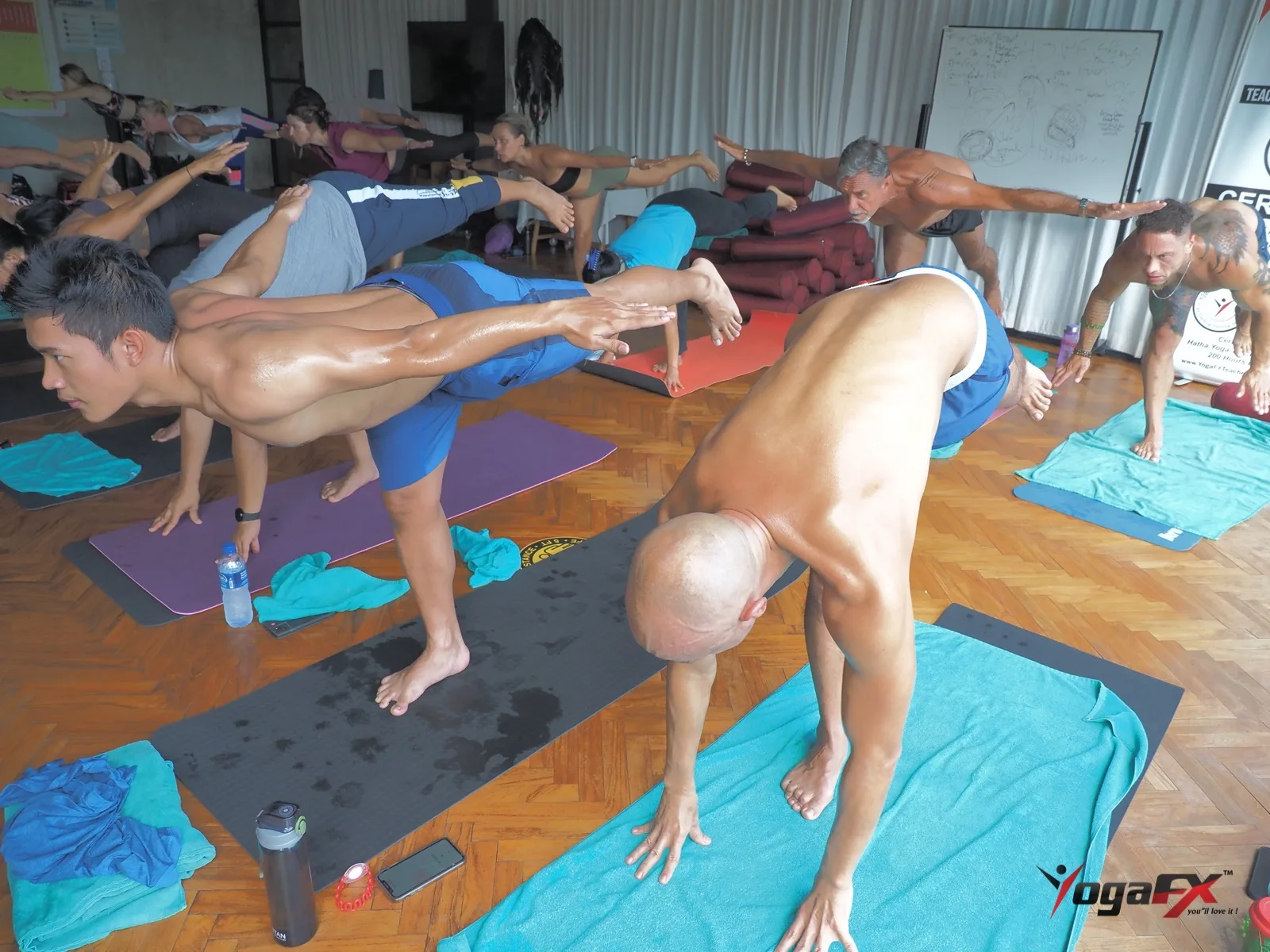
Hot Yoga vs Infrared Sauna at Home: What a Sauna Can and Cannot Do
Let's be fair to the sauna. Many people enjoy it, and enjoying it is a perfectly good reason to use one. The question is only whether it prepares you. Here is the honest split.
What a home sauna may give you
- A calm routine. Sitting still in warmth, breathing slowly, can be a pleasant evening habit that has nothing to do with class.
- A familiar feeling of warmth. You may be less startled by a warm room if you already spend time in one. That is a comfort point, not a proven training effect.
- A hydration habit. Any heat session is a reminder to drink before and after, which is exactly the habit class needs.
What it cannot give you
- Humidity. The class room sits near 40% humidity on purpose, and a cabin is not designed around that.
- Movement under heat. Balancing, bending and breathing while hot is the real task, and you can only practise that by doing it.
- The full 90 minutes. A sauna session ends when you decide. A class runs from start to finish with a teacher guiding the pace.
- Any promise of results. None of the sources we checked tests a home infrared sauna as preparation for hot yoga, so we will not say it works.
In the end, hot yoga vs infrared sauna is a choice between rehearsal and rest, and only one of them is a rehearsal.
Cleveland Clinic also says plainly that a sauna session is not a substitute for a workout. It describes it as passive cardio and notes that more research is needed, especially on infrared saunas. We agree with that caution, and we don't think a cabin makes up for class time.
A Sensible Pacing Plan for Your First Heated Classes
If you are new to heat, borrow the idea behind the CDC guidance, which is to build up slowly. It is the most practical answer to hot yoga vs infrared sauna we can give. This is a practical suggestion from our studio experience, not medical advice, and it is no substitute for talking to your doctor.
- Arrive early. Give your body 10 to 15 minutes in the room before class starts, sitting or lying down. Warm up from rest, not from a rush.
- Drink before you go. Start sipping water hours earlier, not as you walk in. Bring a bottle and sip during class if you need it.
- Rest when you need to. Lying down on your mat is always allowed. Sitting out a posture is smarter than pushing through dizziness.
- Keep early visits regular, not heroic. Two or three classes with rest days between is easier to repeat than a daily push in week one.
- Skip the sauna on class day at first. Two heat sessions back to back add to the load, and you will not know which one made you tired.
- Tell your teacher you are new. They are watching the whole room and can guide your pace.
If you practise at home between classes, our guide to original hot yoga at home shows how to rehearse the postures on a cool floor so that the class feels familiar when the heat arrives.

What Our Students Say About Preparing for the Heat
Our online trainees prepare at home first, then finish with the intensive in Bali. Preparation is a theme in their own words, and it matters more than the hot yoga vs infrared sauna choice:
It is recommended that you come prepared and condition your body for long hours of practice to avoid burnout and to gain optimum benefits.
Joanne, Google review, 2025
I did it, we did it, everyone did it, so I'm proud of myself.
Diah, YouTube review, 2025
Joanne wrote about the teacher training intensive, and her advice reads like pacing advice too: arrive conditioned, arrive ready, and expect long days. Diah is the trainee in the video above, speaking on her last day.
Heat Safety in the Hot Yoga vs Infrared Sauna Choice
Both options are heat exposure, so both deserve respect. Cleveland Clinic states that sauna use is generally viewed as safe but carries the potential for dehydration. It advises you to get out immediately if you feel suddenly dizzy or nauseated. The same rule applies in class: sit down and tell your teacher.
- Pregnancy: Cleveland Clinic warns that sauna use, especially early in pregnancy, can be harmful to the fetus, so ask your healthcare provider before any heat session.
- Medical conditions: If you have a heart, blood pressure or other medical condition, check with your healthcare provider first.
- Fluids: Drink before and after. Sweat loss is not a goal, and it comes back when you rehydrate.
This article is general education, not medical advice. Please consult a healthcare professional about your own situation before changing your heat routine.
Learn the Method With Mr. Ian: Train Online, Finish in Bali
I trained for five years, from 2014 to 2019, with the founder of the Bikram Hot 26&2 method. Since 2017, YogaFX has graduated 1,500+ teachers from 80+ countries. If you want to know why the room is built the way it is, teaching in it is the quickest way to learn. And once you have felt both, hot yoga vs infrared sauna is much easier to judge.
Our Bikram Hot 26&2 Yoga Teacher Training MasterClass is a 6-day hybrid, with online pre-course study at home and an intensive in Bali. Dates for the next intake: arrive Sunday, 24 January 2027, finish Friday, 29 January 2027, at Soham Wellness Center in Seminyak. You leave with two credentials, Yoga Alliance RYT 200-Hour and Bikram Hot 26&2 200-Hour International Yoga Certification.
Right now the Early Bird price is US$1,899, and you can spread it from US$250 per month, interest free. Read original hot yoga teacher training online to see how the home study works, then message us on WhatsApp if you want to talk it through.
FAQ
Can a home infrared sauna prepare me for hot yoga?
Nothing we checked proves it can. A sauna gives you passive warmth, while class adds humidity, movement and 90 minutes of guided practice. It may help you feel calm in a warm space, but the safest preparation is gradual time in the real class, with plenty of water.
Why does a 40°C class feel harder than a hotter sauna?
In class your muscles produce heat for 90 minutes, and the humid air slows how quickly sweat cools you. In a sauna you sit still and can leave whenever you like. The number on the thermometer is only part of the load, so movement and humidity matter more.
How long does it take to get used to hot yoga heat?
It varies by person. CDC and NIOSH workplace guidance suggests building up heat exposure over 7 to 14 days, and less fit people need longer. For class, that means attending regularly, resting whenever you need to, and drinking enough water. If you feel faint at any time, sit down and tell your teacher.
Should I use my sauna on the same day as class?
While you are new to heat, it is wise to keep them on separate days. Both increase fluid loss, and doing them back to back makes it hard to tell what is tiring you. Drink water, rest, and stop if you feel dizzy. Ask your healthcare provider if you have a medical condition.
Is it safe to try hot yoga if I already use a sauna?
Many healthy people do both, but neither replaces medical advice. Heat raises the risk of dehydration, and pregnancy or heart and blood pressure conditions call for a healthcare provider's guidance first. Tell your teacher you are new, rest on your mat whenever you need to, and sip water.
Still have questions? Message Mr. Ian and the YogaFX team on WhatsApp and we will answer them personally.