E-RYT 500 Requirements: A Realistic Timeline for Part-Time Teachers
An E-RYT 500 is a Yoga Alliance teacher who finished a registered 500-hour training and then taught for years. The Yoga Alliance standards document asks for at least four years and 2,000 teaching hours. For someone teaching three to six classes a week around a day job, that is roughly seven to fourteen years.
That number surprises most people, so this guide does the maths in the open. You will see what the E-RYT 500 requirements say, how the hours stack up at different class counts, and how to plan a path that fits a real week. Mr. Ian Terry, founder of YogaFX, holds an E-RYT 500 and has taught more than 12,000 hours, so we speak from the teaching side.
What is E-RYT 500? The meaning in plain words
The letters decode easily. R means registered, Y is yoga, and T is teacher. The E stands for experienced, and 500 is the training hours. So the E-RYT 500 meaning is simple: a registered yoga teacher with 500 training hours and a long record of teaching.
People search "what is E-RYT 500" for two reasons. A student wants to check a teacher's background, and a teacher wants to plan their own path. Both get the same answer. The credential measures time in front of students, not only time in a classroom.
People type it many ways, such as e ryt 500 meaning, what is e ryt 500 or e ryt 500 requirements. The answer is the same each time.
Yoga Alliance uses RYS for schools and RYT for people. An E-RYT 500 is always a person, never a school. Here is how the three levels people confuse most compare:
- RYT 200: 200 training hours, the entry-level credential.
- RYT 500: 500 training hours and at least 100 teaching hours.
- E-RYT 500: 500 training hours, four or more years of teaching and 2,000 teaching hours.
E-RYT 500 requirements: what Yoga Alliance asks for
Yoga Alliance sets the rules in its Standards for RYT Credentials document. We read the 2025 edition for this article. Rules change, so confirm every number on yogaalliance.org before you plan around it.
The standard route to E-RYT 500 has four parts:
- Training. You finish a 500-hour training at a Registered Yoga School, or a 200-hour course plus a separate 300-hour course.
- Time. You teach for at least four years after that training.
- Hours. You log 2,000 teaching hours in total.
- Split. At least 1,500 of those hours come after an RYS 200 or RYS 500 training, and the other 500 come after an RYS 300 or RYS 500 training.
A second route exists for veteran teachers. The Experienced Teacher Pathway asks for about ten years of teaching and 3,000 hours across several modalities. Most part-time teachers will not start there, so we focus on the first route.
Compare that with the level below it. An RYT 500 needs the same 500 hours of training but only 100 teaching hours. That gap of 1,900 hours is the whole reason the E-RYT 500 is rare, and the reason studios treat it as a sign of long experience.
In short, the E-RYT 500 requirements reward patience. Hours, years and training level all have to line up, and none of them can be rushed by paying more. That is good news for part-time teachers, because a steady week beats a heroic month.
Ask Yoga Alliance how it counts a class hour before you start logging. Then keep one simple record from your first day: date, class name, minutes taught and studio. A tidy log saves you a painful rebuild years later.
The hours arithmetic: how long 2,000 teaching hours really takes
Here is the maths most guides skip. We assume 60-minute classes and 48 teaching weeks a year, because holidays, illness and travel eat about four weeks. Your own numbers will differ, but the shape stays the same.
| Classes per week | Teaching hours per year | Weeks to 2,000 hours | Years to 2,000 hours |
|---|---|---|---|
| 3 | 144 | 667 | 13.9 |
| 4 | 192 | 500 | 10.4 |
| 5 | 240 | 400 | 8.3 |
| 6 | 288 | 333 | 6.9 |
If your classes run 90 minutes, like a Hot 26&2 class, scale the table. Four 90-minute classes a week equal six teaching hours, so you would reach 2,000 hours in about 6.9 years, not 10.4.
Notice what the table says about the four-year minimum. To finish in exactly four years, you would need about 10.4 teaching hours every week. That is a full-time load. For a part-timer, the hours rule decides the timeline, and the four-year rule never gets a vote.
A realistic E-RYT 500 timeline for part-time teachers
Picture a teacher with a nine-to-five job who teaches four 60-minute classes a week. This is an example, not a real person. Their log grows like this:
- Year 1: about 192 hours.
- Year 3: about 576 hours.
- Year 5: about 960 hours.
- Year 8: about 1,536 hours.
- Year 10: about 1,920 hours, with the 2,000 mark arriving a few weeks into year 11.
The split rule adds a planning twist. As we read the standards, 500 of your 2,000 hours must come after an RYS 300 or RYS 500 training. At 192 hours a year, those 500 hours take about 2.6 years. So you should finish your 300-hour training at least that long before your target date, or those last hours will not count where you need them.
That is also why the first rung matters. You cannot log a single E-RYT 500 hour until you hold a registered training and begin teaching. If you are still at the start, our guide to what RYT 200 means and how to earn it online shows how people with full-time jobs get that first credential.
Fitting E-RYT 500 hours around a day job: what the research says
A long road only works if your body and your calendar survive it. Three findings are worth knowing before you add classes to a working week.
Long working weeks carry a measurable cost
A joint WHO and ILO report from 2021 found that working 55 or more hours a week is associated with a 35% higher risk of stroke and a 17% higher risk of dying from ischemic heart disease, compared with 35 to 40 hours. That is an association, not proof of cause.
Still, a 40-hour job plus six teaching hours, prep and commuting can drift toward that line, so count the hidden hours before you add a class.
Your own practice still needs room
The NHS guidance for adults aged 19 to 64 recommends at least 150 minutes of moderate activity a week, or 75 minutes of vigorous activity, plus strengthening work on at least two days. The NHS lists yoga as one way to meet the strengthening goal. Teaching other people is not the same as practising yourself, so protect two or three personal sessions a week.
Spread your study out, do not cram it
A 2006 meta-analysis in Psychological Bulletin pooled 839 assessments from 317 experiments. It found that the best gap between study sessions grows with how long you need to remember the material. For you, that means short, regular study blocks beat one exhausting weekend when you tackle the 300-hour modules or learn a new class format.
This is general information, not medical advice. If you have a health condition or a heavy schedule, consult a healthcare professional before you add training load.
Seven ways to add teaching hours without burning out
Small, steady changes beat heroic ones. These habits help part-time teachers close the gap without wrecking their week:
- Keep one fixed weekly class. A regular slot builds a loyal group and a reliable log.
- Add classes in steps. Go from three to four a week, hold it for a season, then reconsider.
- Cover substitute shifts. Studios remember teachers who say yes at short notice.
- Teach where you already are. A lunchtime class near your office saves travel time.
- Log the same day. A two-minute entry beats a Sunday reconstruction.
- Ask what counts. Check with Yoga Alliance whether workshops and private lessons qualify.
- Plan rest weeks. The 48-week assumption in our table already allows for them.
Think of the weekly load as a budget. Your job, your family and your own practice already spend most of it. Teaching hours must come from what is left, so a teacher who guards two free evenings will outlast one who says yes to everything.
If you want to see how that planning looks for a credential that asks for fewer hours, read our step-by-step guide to yoga continuing education with a day job. It uses the same weekly-block idea.
Where the first 500 hours begin: the YogaFX route
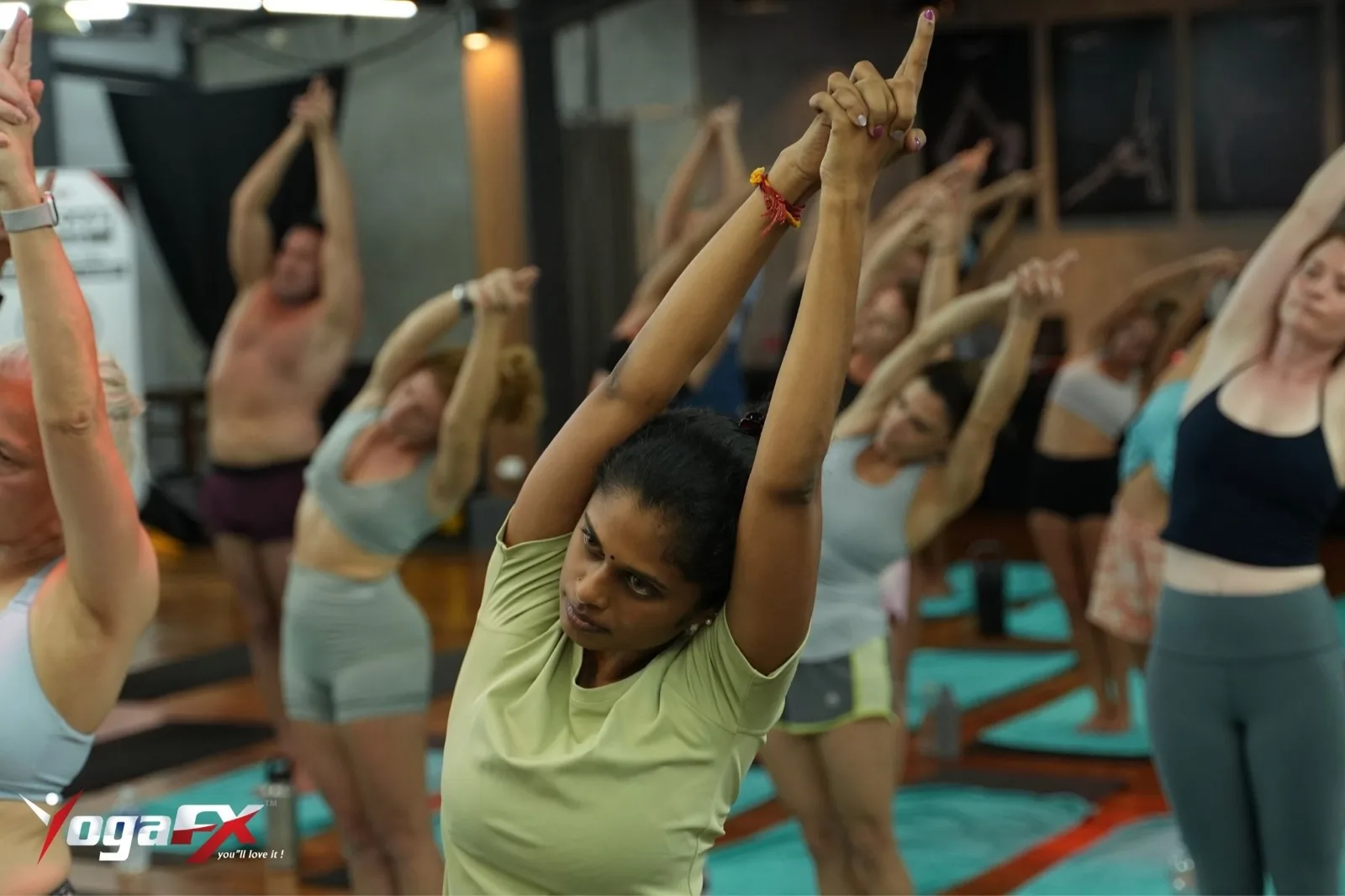
YogaFX cannot shortcut the teaching years, and nobody honest can. What we do is build the first rung. Our MasterClass is a 6-day hybrid: you study online before the course, then finish with an intensive in Bali. Graduates earn the Yoga Alliance RYT 200 plus the Bikram Hot 26&2 200-Hour International Yoga Certification.
The next batch checks in on Sunday 24 January 2027 and checks out on Friday 29 January 2027, at Soham Wellness Center in Seminyak. Since 2017, more than 1,500 graduates from 80+ countries have trained with us. Because the course is hybrid, you take about five days off work, not five weeks.
If you want the full picture, these two guides are the best next reads:
- Original hot yoga teacher training online shows how to start the dialogue at home.
- Yoga Alliance certification requirements for working adults walks through registering as an RYT 200.
Readers in the UK sometimes ask how the RYT 500 and E-RYT 500 labels differ in plain terms. For that comparison, see this plain-language RYT 500 explainer from our UK site.
Is the E-RYT 500 worth chasing on a part-time schedule?
It depends on what you want from teaching. If you teach for joy and a little income, you may never need it. An RYT 200 and a good reputation fill most timetables, and students rarely ask about your credential level.
The picture changes if you want to lead teacher trainings. A school that runs its own training needs trainers who hold the senior credential, so the E-RYT 500 opens a door that the lower levels don't. It also signals to studio owners that you stay in the work for the long run.
For most part-time teachers, the honest plan has three steps. First, earn your RYT 200 and start teaching. Second, log every hour from day one. Third, decide around year three whether the 300-hour course and the long climb still fit your life. You're free to stop at any rung, and each rung is a real credential on its own.
Mr. Ian Terry and what 12,000 teaching hours looks like
Mr. Ian Terry holds an E-RYT 500 and has taught more than 12,000 hours. That is six times the 2,000-hour minimum. He trained for five years, from 2014 to 2019, with the founder of the Bikram Hot 26&2 method. In June 2026 he was named Master Trainer of the Republic of Indonesia Yogasana Sports Federation.
Those hours show up in the training room. A trainer with that history has seen a trainee rush the dialogue, lose their place, or push a student too far in 40°C heat. That is the experience a trainee absorbs in six days, and it is what the E in E-RYT is meant to signal. YogaFX runs studios in Seminyak and Canggu, so trainees see it in daily classes too. If you are still at the start, read how to become a Bikram yoga teacher first, and begin with Bikram yoga teacher training online.
What students say about learning from experienced teachers
Credentials describe hours. Students describe the room. Here are three accounts from our review store, shared with first names only.
"Absolutely amazing, fun and energetic instructor! Thank you Mr Ian."
Trizz, Google review, 2020
Lars said the training was "more than I expected." He described a week of kindness, including emotional moments on the mat that he called an important point in his journey. Lars, YouTube review, 2026.
Samantha thanked her trainer for showing what it really means to be passionate about yoga, and said it is not just about the poses. Samantha, YouTube review, 2019 (lightly paraphrased).
These are personal accounts, so individual results vary. They are not a promise about credentials or timelines.
FAQ
What does E-RYT 500 mean?
E-RYT 500 stands for Experienced Registered Yoga Teacher at the 500-hour level with Yoga Alliance. The teacher finished a registered 500-hour training and then taught for years. The E marks proven teaching experience, not extra study. It is a senior credential, usually held by lead trainers and mentors.
How do you become an E-RYT 500?
Finish a 500-hour training at a Registered Yoga School, either as one course or a 200-hour plus a 300-hour course. Then teach for at least four years and log 2,000 teaching hours, with 1,500 after an RYS 200 or 500 training. Confirm the current rules with Yoga Alliance.
What is the difference between RYT and E-RYT?
An RYT has completed registered training and a small number of teaching hours, for example 100 for an RYT 500. An E-RYT adds years of verified teaching on top, such as 2,000 hours for the E-RYT 500. So the RYT shows study, while the E-RYT shows study plus experience.
How long does an E-RYT 500 take for a part-time teacher?
At 60-minute classes and 48 teaching weeks a year, three classes a week take about 13.9 years, four take 10.4, five take 8.3, and six take 6.9. The four-year minimum never limits a part-timer. The 2,000-hour total sets the pace.
Do you need an E-RYT 500 to teach hot yoga?
No. Most hot yoga studios ask for an RYT 200 plus a style certification, such as Bikram Hot 26&2. An E-RYT 500 matters later, if you want to lead teacher trainings or mentor other teachers. It is a long-term goal, not an entry requirement. For the very first step, see do you need a license to teach yoga.
Still have questions? Message Mr. Ian and the YogaFX team on WhatsApp and we will answer them personally. Ask about timelines, the 300-hour course, or the 6-day hybrid MasterClass, whatever you are weighing up.